

Effective MRCOG Part 2 preparation is built on current UK guidelines, weekly timed practice of both SBAs and EMQs, and extra attention to EMQ technique, because EMQs carry 60% of the marks within each paper. Many doctors in full-time clinical work plan for about 16 weeks of structured study.
This guide covers what the format means for your strategy, how to read guidelines, a 16-week plan, question technique, using recalls safely, timing on the day and the mistakes to avoid.
Table of Contents
What the format means for MRCOG Part 2 preparation
The format tells you where to spend your practice time: EMQs carry more of the marks and get more of the clock. You must pass Part 1 before you can sit Part 2, and you submit an Expression of Interest (EOI) for each sitting.
| Feature | Detail |
|---|---|
| Papers | 2 computer-based papers, each worth 50% of the score |
| Each paper | 50 SBAs and 50 EMQs in 3 hours |
| Weighting within a paper | SBAs 40%, EMQs 60% |
| Pass mark | One combined, standard-set pass mark; no separate SBA or EMQ pass mark |
| RCOG suggested timing | About 70 minutes for SBAs and 110 minutes for EMQs per paper |
| Break | Lunch break of about an hour after Paper 1 |
Three things follow for your MRCOG Part 2 preparation. First, with 50 of each question type, an EMQ carries on average about one and a half times the weight of an SBA. Second, there is no separate hurdle for each type, so strong EMQs can offset weaker SBAs and the reverse.
Third, the pace differs. The RCOG split works out at about 84 seconds per SBA and about 2 minutes 12 seconds per EMQ, so practise both speeds. For the full detail on papers, centres and fees, see our MRCOG Part 2 exam format guide.
Build your reading on UK guidelines
MRCOG Part 2 preparation should centre on guidelines rather than textbooks, because Part 2 tests how you apply current UK guidance to clinical scenarios. Questions usually ask for the best diagnosis, investigation or next management step.
Anchor your reading on four bodies of guidance. The RCOG Green-top Guidelines cover much of obstetric and gynaecological management. NICE guidance covers broad areas of pregnancy and women’s health, BASHH guidelines cover sexually transmitted infections, and FSRH guidance covers contraception.
Read each guideline in the same way. Start with the summary of recommendations, then read the sections behind any recommendation you did not know. Write down the numbers that matter (cut-offs, timings, doses, when to refer or deliver) and do questions on that guideline in the same week, so you practise applying it rather than just recognising it.
Always check you are using the current version, since outdated guidance is a common trap in MRCOG Part 2 preparation. Our guide on how to master GTG, NICE, BASHH and FSRH guidelines explains how to prioritise and summarise them.
A 16-week MRCOG Part 2 preparation plan
This plan assumes about 12 to 15 hours of study a week alongside a full-time rota. The volumes are suggestions, so scale them to your time, and keep an error log from day one.
| Weeks | Focus | Output by end of block |
|---|---|---|
| 1 | Read the RCOG Part 2 syllabus; list key guidelines per area; untimed baseline of about 25 SBAs and 25 EMQs | Guideline reading list; weak areas ranked |
| 2 to 5 | Obstetrics block: antenatal care, maternal and fetal medicine, labour and delivery, postnatal care. About 75 SBAs and 75 EMQs a week | Guideline notes; error log by topic |
| 6 to 9 | Gynaecology block: menstrual disorders, early pregnancy, reproductive medicine, menopause, urogynaecology, gynaecological oncology. Same volume | Gynaecology notes complete |
| 10 and 11 | Sexual and reproductive health, plus governance, audit and research. First full timed paper (100 questions in 3 hours) | Score split by SBA and EMQ |
| 12 and 13 | Mixed timed sets at RCOG pacing; re-read weakest guidelines; second full timed paper | Top 10 weak topics; pacing target met |
| 14 and 15 | Full two-paper mock day with a lunch break; targeted revision | Error log reviewed twice |
| 16 | Light revision of key numbers and recommendations; logistics | Final-week checklist done |
Booking opens well before the exam, so fix your sitting first and count your MRCOG Part 2 preparation back from it. The dates below are the confirmed ones for 2027; recheck the RCOG Part 2 key dates page before each sitting.
| Sitting | EOI closes | Booking window | Exam | Results |
|---|---|---|---|---|
| January 2027 | Fri 2 Oct 2026 | 27 Oct to 15 Dec 2026 | Wed 20 Jan 2027 | Wed 17 Feb 2027 |
| July 2027 | Tue 30 Mar 2027 | 20 Apr to 15 Jun 2027 | Wed 14 Jul 2027 | Wed 11 Aug 2027 |
EMQ and SBA technique
Good technique in both formats starts the same way: read the lead-in, form your answer from the scenario, then go to the options. An EMQ gives you a theme, a long option list and several scenarios, while an SBA gives one scenario with a short list of options.
For EMQs, the lead-in is everything. “Most appropriate initial management” and “most appropriate next investigation” lead to different answers from the same scenario. Predict before you scan, because long lists make it easy to be drawn to a familiar option, and use the clues in the stem: gestation, parity, observations and results are there for a reason.
Many EMQ items test the next step in a guideline pathway rather than the final treatment. If two options fit, choose the more likely one in a UK setting, flag it and move on.
For SBAs, several options will look plausible. Rule out those that are true but do not answer the question asked, and choose the option that explains every finding in the scenario. Build both kinds of practice into your MRCOG Part 2 preparation every week, rather than saving EMQs for later.
Using recalls without being misled
Recalls can help you learn the style and spot common themes, but they are candidates’ memories, not official papers. The RCOG does not publish its live exam questions, so wording, options and even the “correct” answers in circulation may be wrong.
Use them to spot themes, not to learn answers. Check every answer against the current guideline before you commit it to memory, and never let recalls replace the syllabus, which is wider than any recall set. Our guide to revising SBAs and EMQs from recent recalls explains how to use them safely within your MRCOG Part 2 preparation.
Timing strategy on exam day
Plan your 180 minutes before you sit down, and protect the EMQ time. You manage your own time within each paper, so a fixed split with checkpoints stops one difficult section from eating the rest.
| Paper segment | Suggested time | Checkpoint |
|---|---|---|
| SBAs (50) | About 70 minutes | 25 SBAs done by about 35 minutes |
| EMQs (50) | About 110 minutes | 25 EMQs done about 55 minutes into the EMQ section |
| Review | Within the above | Leave 5 to 10 minutes to revisit flagged questions |
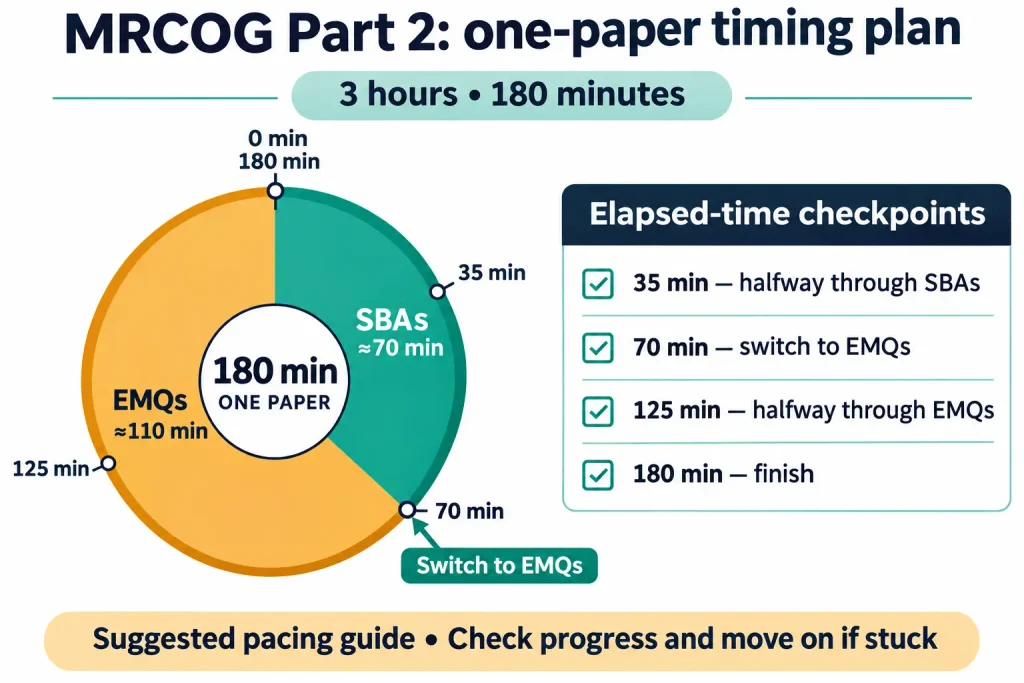
Answer every flagged question before time runs out. Use the lunch break after Paper 1 to eat and rest rather than replaying your answers. Rehearse this exact split in at least two full mocks during your MRCOG Part 2 preparation so that it feels routine on the day.
Common mistakes to avoid
Most avoidable failures in MRCOG Part 2 preparation come from uneven coverage, too little EMQ practice and treating recalls as the syllabus. Candidates also lose marks by learning from outdated guideline versions and by picking an answer that is correct but not the best fit for the question.
Two more are easy to fix. Sit at least one full three-hour paper under timed conditions well before the exam, and get someone to look at your weak areas, because a mentor or study group spots blind spots that self-study misses.
Fitting MRCOG Part 2 preparation around a rota is hard. The timetabling advice in our guide on balancing MRCOG preparation with clinical duties applies to Part 2 as well.
Frequently asked questions
How long should MRCOG Part 2 preparation take?
Many candidates in full-time clinical work plan for about 16 weeks. If you already know the main UK guidelines well you may need less, but keep at least four weeks for timed papers and revision.
Are EMQs or SBAs more important in Part 2?
Within each paper EMQs carry 60% of the marks and SBAs 40%, and the RCOG suggests about 110 minutes for EMQs and 70 for SBAs. Both matter, but EMQ practice usually deserves more of your MRCOG Part 2 preparation time.
Is there a separate pass mark for SBAs and EMQs?
No. The RCOG sets one combined, standard-set pass mark, so your MRCOG Part 2 preparation should aim at your overall score rather than at each question type separately.
Which guidelines matter most for MRCOG Part 2 preparation?
Focus on RCOG Green-top Guidelines, relevant NICE guidance, BASHH guidelines on sexually transmitted infections and FSRH guidance on contraception. Always use the current version.
Are recalls the same as past papers?
No. The RCOG does not publish its live exam questions, so recalls are reconstructions from candidates’ memories and may contain errors. Use them for themes and style in your MRCOG Part 2 preparation, and check every answer against the guideline.
How many questions should I practise before Part 2?
There is no official number. Our 16-week MRCOG Part 2 preparation plan suggests about 75 SBAs and 75 EMQs a week during the reading blocks, plus at least two full timed papers and one two-paper mock day.
Ready for guided MRCOG Part 2 preparation? Talk to our MRCOG team or see our MRCOG Part 2 course, which covers the guidelines module by module with SBA and EMQ practice and full timed mocks.
Related guides: MRCOG Part 2 exam format · MRCOG Part 1 and Part 2 booking dates · MRCOG Part 1 and Part 2 results · Revising SBAs and EMQs from recalls · Final weeks before the exam
Sources: RCOG Part 2 exam format · RCOG Part 2 key dates and fees · RCOG Part 2 syllabus · RCOG Green-top Guidelines