
Your career after MRCOG depends far more on where you want to work than on the qualification itself: in the UK it is part of specialty training and a GMC acceptable qualification, in the UAE it is recognised under the Unified PQR, and in India it is valid but not equivalent to MD/MS. MRCOG opens doors, but each country’s regulator decides which ones and at what grade. The doctors who do best treat the exam and their licensing plan as one project.
This guide covers the realistic options in the UK, the UAE, other Gulf countries and India, how special interests develop, and what Fellowship means later on.
Table of Contents
What a career after MRCOG looks like
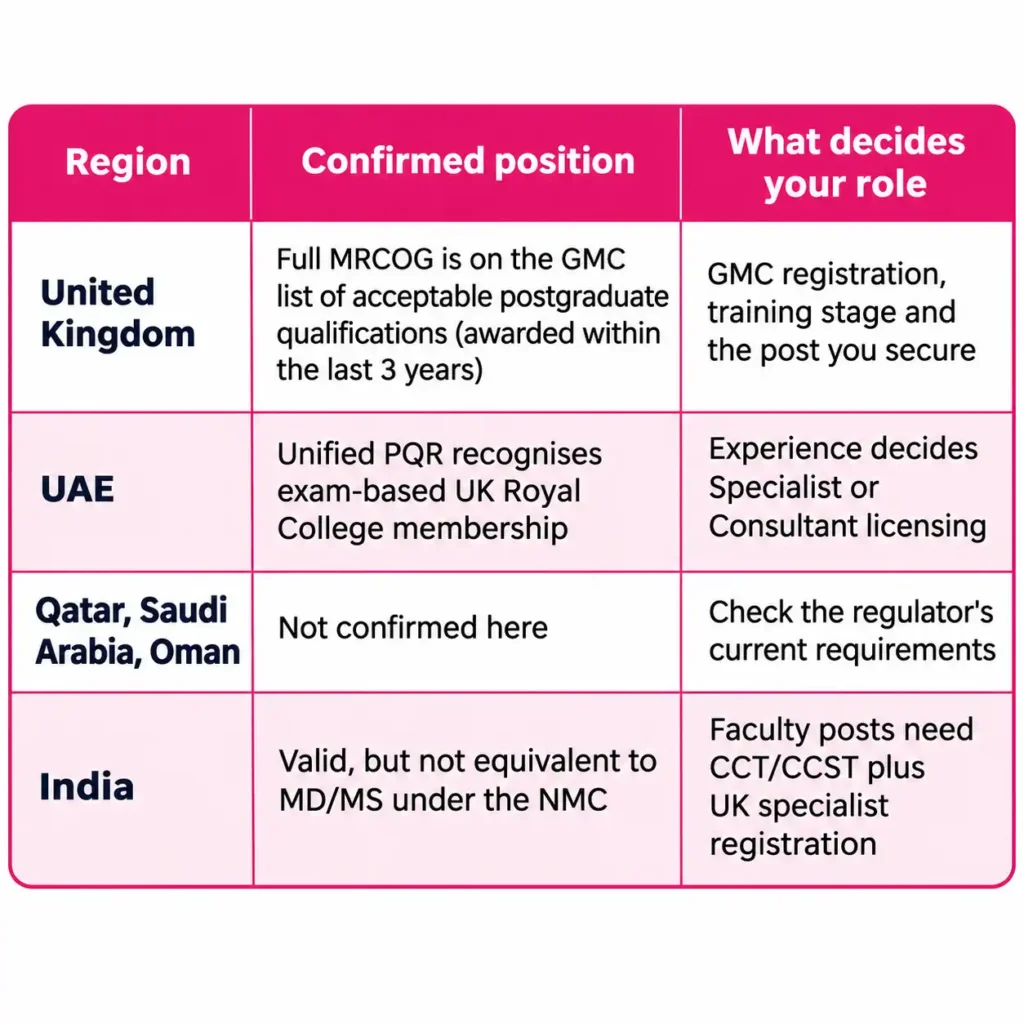
There is no single route. Completing all three parts leads to the award of MRCOG, but it does not by itself give you specialist or consultant status, so the next step is always a licence, a post, or further training. The table gives a quick view of the confirmed position in each region.
If you are still deciding whether the exam is right for you, our guide to the benefits of MRCOG sets out what it does and does not do. For background on the three parts, see what MRCOG is.
Career after MRCOG in the UK
In the UK, MRCOG is woven into specialty training rather than added at the end. UK trainees are expected to pass Part 1 by ST3 and Parts 2 and 3 by ST6, so for them the exam is a milestone on the way to completing training and joining the Specialist Register.
For doctors trained outside the UK, the key fact is that full MRCOG is on the GMC list of acceptable postgraduate qualifications when awarded within the last three years. That matters for registration, but it is not a job offer. You still need GMC registration and a suitable post, and the grade you start at depends on your experience and the role.
Plan the timing of your career after MRCOG with care. The three-year window means that passing Part 3 and then waiting years to apply can leave you outside it, so map out registration alongside your exam dates.
Working in the UAE
The UAE gives the clearest Gulf picture, because the Unified Professional Qualification Requirements (PQR) recognise exam-based UK Royal College membership. You can read the current requirements through the Ministry of Health and Prevention.
What MRCOG does not decide is your grade. Whether you are licensed as a Specialist or a Consultant depends on your post-qualification experience. Two doctors with the same MRCOG can therefore be licensed at different levels, and that difference shapes the posts open to each of them.
For a career after MRCOG in the UAE, keep careful records of your O&G posts, dates and responsibilities from the start. Those records are what a licensing review will look at, and gathering them years later is much harder.
Qatar, Saudi Arabia and Oman
For Qatar, Saudi Arabia and Oman we cannot confirm how each regulator currently treats MRCOG, so check the regulator’s current requirements before you plan around it. Licensing rules, grade criteria and the experience each regulator expects can all change, and the regulator’s own website is the only safe source.
For a career after MRCOG in these countries, a practical first step is to contact the relevant regulator early, ideally before Part 3, and ask what it needs from a doctor with your qualifications and experience. Then build your MRCOG career plan around that answer rather than around what colleagues found a few years ago.
Career after MRCOG in India
In India, MRCOG is a valid qualification, but the NMC does not treat it as equivalent to MD/MS. That single fact shapes most decisions about a career after MRCOG in India, particularly for doctors interested in teaching.
For medical-college faculty posts, UK qualifications count only with CCT/CCST plus UK specialist registration. So if an academic post in India is your aim, MRCOG alone will not get you there, and you need either an Indian postgraduate degree or the full UK specialist route. Our comparison of MRCOG vs DNB looks at how the two routes fit together.
Outside academic posts, a career after MRCOG in India often centres on stronger clinical practice and standing with patients and colleagues, or on working abroad later. It is worth being clear with yourself about which of those you want, because it changes how you plan the next five years.
Developing a special interest
Most consultants in obstetrics and gynaecology develop a special interest, and your MRCOG career is a good time to start shaping one. Common areas include fetal and maternal medicine, reproductive medicine, gynaecological oncology, urogynaecology, early pregnancy care and minimal access surgery.
How you develop that interest depends on the country. In the UK it usually happens through training posts and further accredited training. Elsewhere it tends to come through experience in specialist units, courses and audit or research work. Whichever route you take, keep a record of cases, procedures and teaching, because that evidence travels with you.
Teaching and medical education offer another path for your career after MRCOG. Many members teach juniors or help prepare candidates for the exam, which also keeps your own knowledge current.
If you need more hands-on O&G experience before you can build any of these interests, the StudyMEDIC two-year Clinical Program offers a structured hospital-based option.
Fellowship and the long view
FRCOG is the long-term recognition in a career after MRCOG. It is not an exam: Fellows are elected, normally after ten or more years as a member, in recognition of their contribution to the specialty. Our guide on MRCOG vs FRCOG explains how the two differ.
A simple way to plan a career after MRCOG is to work backwards from the country and role you want.
| Step | When | What to do |
| Choose a destination | Before Part 2 | Read that regulator’s current requirements |
| Keep evidence | During Part 2 and Part 3 preparation | Log O&G posts, procedures and responsibilities |
| Apply | After Part 3 | Seek registration or licensing while your qualification is recent |
| Specialise | First years in post | Build an interest through cases, audit and teaching |
Pay is the question most doctors ask next. It depends on country, licence grade, experience and sector, and our guide to MRCOG salary explains how to find official pay information for each system. If you trained outside the UK, MRCOG for international doctors covers eligibility and the exam pathway in more depth.
Frequently asked questions
Does MRCOG make me a consultant?
No. Completing the three parts leads to the award of MRCOG, not to specialist or consultant status. Your grade depends on the regulator and your experience.
What does a career after MRCOG in the UK involve?
Full MRCOG is a GMC acceptable postgraduate qualification if awarded within the last three years. You still need GMC registration and a suitable post.
Can I work as a Consultant in the UAE with MRCOG?
The UAE Unified PQR recognises exam-based UK Royal College membership, but whether you are licensed as a Specialist or Consultant depends on your experience.
Is MRCOG accepted in Qatar, Saudi Arabia or Oman?
We cannot confirm the current position, so check the regulator’s current requirements before you plan a career after MRCOG there.
Can I teach in an Indian medical college with MRCOG?
Not with MRCOG alone. UK qualifications count for faculty posts only with CCT/CCST plus UK specialist registration.
When should I start planning my career after MRCOG?
Start while you are still sitting the exams. Licensing rules, experience records and the GMC three-year window all reward early planning.
Talk to our MRCOG team about planning your exams around your career goals, or see the MRCOG Part 3 course if you are on the final step.
Related guides:
Sources: