

The MRCOG Part 2 exam format is two computer-based papers, each with 50 single best answer questions (SBAs) and 50 extended matching questions (EMQs) in 3 hours. Each paper counts for half your score, EMQs carry 60% of the marks within a paper, and one combined, standard-set pass mark decides the result.
This guide covers the papers, what SBAs and EMQs look like, weighting and the pass mark, timing, eligibility and attempts, centres, fees and dates, and what to do next.
Table of Contents
MRCOG Part 2 exam format at a glance
Part 2 is the second of the three MRCOG exams, taken after you pass Part 1. Its questions are built around clinical scenarios in obstetrics and gynaecology, delivered as two papers on computer at Pearson VUE centres.
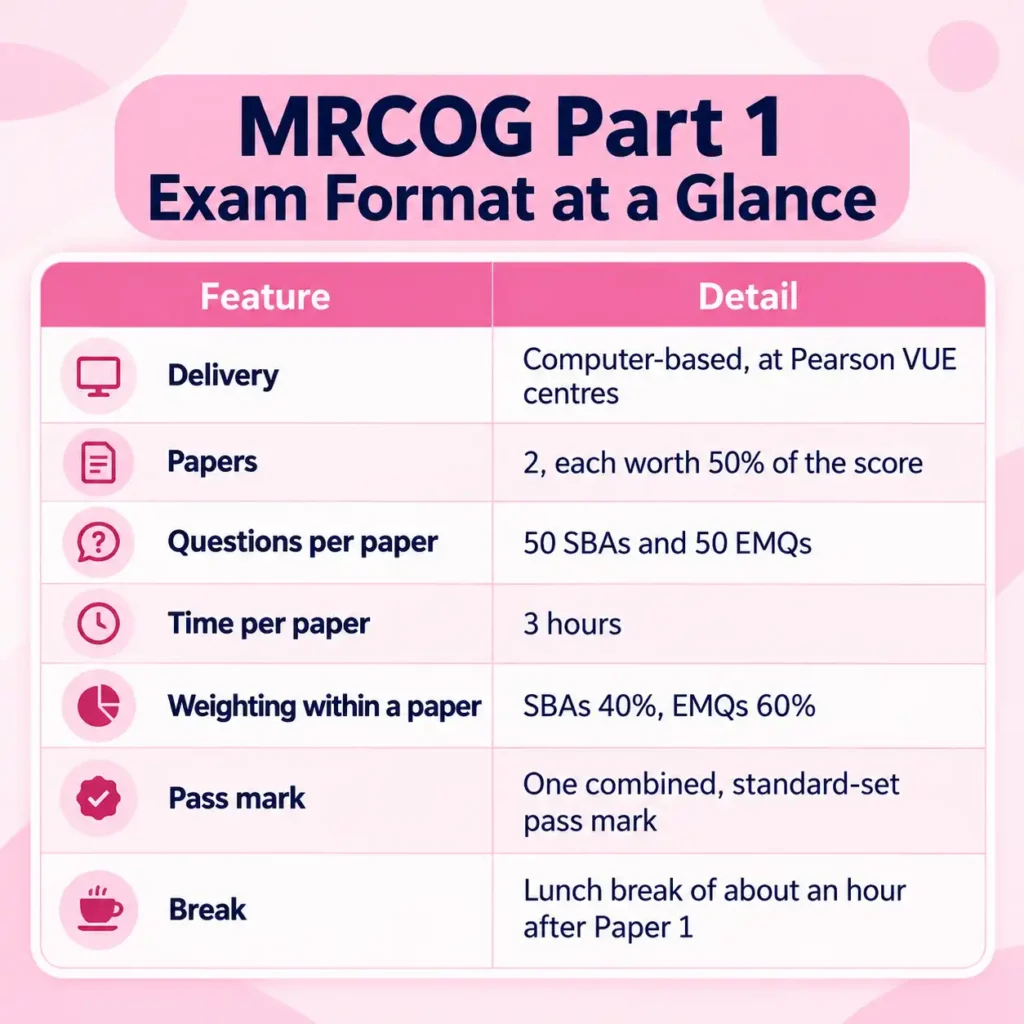
That is 200 questions over two papers in one day. If you are coming from Part 1, the biggest change in the MRCOG Part 2 exam format is the EMQ, and it deserves most of your attention. The RCOG Part 2 format page is the official reference.
What SBAs and EMQs look like
The MRCOG Part 2 exam format uses two question types that both test clinical judgement but are built differently. An SBA gives you one clinical scenario, a lead-in question and a short list of options, and you choose the single best answer. Several options may be partly right, so the skill is picking the one that fits the whole scenario.
An EMQ starts with a theme and a longer list of options, followed by several clinical scenarios that draw on the same list. Each scenario has its own lead-in, such as the most appropriate next investigation or the most likely diagnosis, and you choose one option for each.
Here is how the two question types in the MRCOG Part 2 exam format compare, described generically:
| Part of the question | SBA | EMQ |
|---|---|---|
| Opening | A clinical scenario | A theme and a long option list |
| Lead-in | One question about that scenario | A question for each scenario |
| Options | A short list | One shared list used across scenarios |
| Your task | Choose the single best answer | Match each scenario to the best option |
The long shared list is what makes EMQs feel different. Read the lead-in first and decide what you are looking for before scanning the options, or a familiar answer will pull you in.
Weighting and the pass mark
Within each paper of the MRCOG Part 2 exam format, SBAs carry 40% of the marks and EMQs 60%. The two papers carry equal weight, each counting for 50% of your score.
| Paper 1 | 50% of the score |
| Paper 2 | 50% of the score |
| SBAs within a paper | 40% |
| EMQs within a paper | 60% |
With 50 of each question type in a paper, an EMQ carries on average about one and a half times the weight of an SBA. That is the main reason EMQ practice pays off.
There is one combined, standard-set pass mark in the MRCOG Part 2 exam format, with no separate pass mark for SBAs or EMQs. A strong EMQ score can therefore balance a weaker SBA score, and the reverse. For how results are released, see our guide to MRCOG Part 1 and Part 2 results.
Timing within each paper
Within the MRCOG Part 2 exam format, the RCOG suggests spending about 70 minutes on the SBAs and about 110 minutes on the EMQs in each 3-hour paper. That works out at roughly 84 seconds per SBA and 2 minutes 12 seconds per EMQ.
| SBAs | 50 | About 70 minutes | About 84 seconds |
| EMQs | 50 | About 110 minutes | About 2 minutes 12 seconds |
| Whole paper | 100 | 3 hours |
You manage your own time within the paper, so set checkpoints. Halfway through the SBAs should be at around 35 minutes, and leaving a few minutes to revisit flagged questions is wise. Paper 1 is followed by a lunch break of about an hour; use it to eat and rest rather than go over answers. Practising this split in full mocks until it feels automatic is the best way to make the MRCOG Part 2 exam format work in your favour.
Eligibility, attempts and time limits
To sit Part 2 you must have passed Part 1, and you submit an Expression of Interest (EOI) for every sitting. There are no exemptions from any part of MRCOG. These rules sit alongside the MRCOG Part 2 exam format and matter just as much when you plan your sittings.
| Rule | What it means |
|---|---|
| Eligibility | Pass Part 1 first; EOI for each sitting |
| Attempt limit | Maximum 6 attempts only on the UK Specialist Register route; otherwise no limit |
| Time limit after Part 1 | Attempt Part 2 within 10 years of passing Part 1 (7 years pro rata on the UK Specialist Register route) |
| After Part 2 | Attempt Part 3 within 7 years (pro rata) of passing Part 2 |
| Part 3 link | After 4 unsuccessful Part 3 attempts, you must retake Part 2 |
The last row surprises many candidates. A Part 2 pass is not permanent if Part 3 goes badly four times, so it is worth planning the whole journey. Our guide to what MRCOG is shows how the three parts connect.
Exam centres, fees and dates
Part 2 is sat at Pearson VUE centres, and the fee depends on the band of the centre you choose, not where you live. The 2027 fees are the same for Part 1 and Part 2.
| Exam centre band | Part 2 fee 2027 |
|---|---|
| UK and Ireland | £589 |
| Band A (includes UAE, Qatar, Saudi Arabia, Oman, Kuwait, Bahrain, Malaysia) | £710 |
| Band B (includes India, Pakistan, Egypt, Sri Lanka, Bangladesh, Nepal, Nigeria) | £613 |
| Band C | £489 |
If you sit in India, GST has applied to Part 1 and Part 2 fees since January 2025, so check the total at checkout. The RCOG country bandings page lists every country.
| Sitting | EOI closes | Booking window | Exam | Results |
|---|---|---|---|---|
| January 2027 | Fri 2 Oct 2026 | 27 Oct to 15 Dec 2026 | Wed 20 Jan 2027 | Wed 17 Feb 2027 |
| July 2027 | Tue 30 Mar 2027 | 20 Apr to 15 Jun 2027 | Wed 14 Jul 2027 | Wed 11 Aug 2027 |
Our MRCOG Part 1 and Part 2 booking dates guide is updated each sitting with any changes.
What to do next
Once you understand the MRCOG Part 2 exam format, turn it into a study plan. Build your reading on current UK guidelines, practise both question types every week and sit full timed papers well before the exam.
A useful first step is a diagnostic paper. Sit 50 SBAs and 50 EMQs under the real timings of the MRCOG Part 2 exam format and note where the minutes go, which topics slow you down and which question type costs you more marks. Many candidates find the EMQs take longer than they expected, and it is far better to discover that in week one than in the exam hall.
Our MRCOG Part 2 preparation strategy sets out a 16-week plan. For guideline reading, see how to master GTG, NICE, BASHH and FSRH guidelines, and for using candidate recalls safely, read our guide to revising SBAs and EMQs from recalls.
Frequently asked questions
How many questions are in the MRCOG Part 2 exam format?
There are 200 questions in total. Each of the two papers has 50 SBAs and 50 EMQs.
How long is each Part 2 paper?
Each paper lasts 3 hours. Within the MRCOG Part 2 exam format, the RCOG suggests about 70 minutes for SBAs and 110 minutes for EMQs.
How are marks weighted in the MRCOG Part 2 exam format?
Each paper is worth 50% of the score. Within a paper, SBAs carry 40% and EMQs 60%.
Is there a separate pass mark for SBAs and EMQs?
No. The MRCOG Part 2 exam format has one combined, standard-set pass mark across the exam.
How many times can I sit MRCOG Part 2?
A maximum of 6 attempts applies only on the UK Specialist Register route; otherwise there is no limit. You must attempt Part 2 within 10 years of passing Part 1 (7 years pro rata on the UK Specialist Register route).
Is there a break between the two papers?
Yes. In the MRCOG Part 2 exam format, Paper 1 is followed by a lunch break of about an hour, so plan to eat and rest.
Where is MRCOG Part 2 held?
At Pearson VUE centres. Your fee band follows the centre you choose, so a centre in India is Band B and one in the UAE is Band A.
Ready to prepare for the MRCOG Part 2 exam format? Talk to our MRCOG team or see our MRCOG Part 2 course, with SBA and EMQ practice and full timed mocks.
Related guides: MRCOG Part 2 preparation strategy · MRCOG Part 1 and Part 2 booking dates · MRCOG Part 1 and Part 2 results · What is MRCOG
Sources: RCOG Part 2 exam format · RCOG Part 2 key dates and fees · RCOG country bandings · RCOG MRCOG overview