
The MRCOG vs FRCOG difference is simple once you see it: MRCOG is the membership you earn by passing three exams, while FRCOG is a fellowship the RCOG elects members to, normally after 10 or more years as a member. You never choose one instead of the other; MRCOG comes first and FRCOG, if it comes, comes much later.
This guide covers what each title means, the timeline between them, how to prepare for MRCOG part by part, and how to think about fellowship across your career.
Table of Contents
MRCOG vs FRCOG at a glance
Membership is earned by examination; fellowship is earned by a career. The MRCOG vs FRCOG table below shows how differently the two work.
| MRCOG | FRCOG | |
|---|---|---|
| What it is | Membership of the Royal College of Obstetricians and Gynaecologists | Fellowship of the Royal College of Obstetricians and Gynaecologists |
| How you get it | Pass Part 1, Part 2 and Part 3 | Elected by the RCOG; not an exam |
| Who can get it | Doctors who meet the eligibility rules for each part | Members, normally after 10 or more years of membership |
| Preparation | Structured exam revision for each part | A long professional career as a member |
| Timescale | Depends on how quickly you clear each part, within time limits | Normally a decade or more after becoming a member |
| Fees | 2027 exam fees per part by exam-centre band | Check the RCOG website for current details |
| Career role | On the GMC list of acceptable postgraduate qualifications | A senior mark of standing within the College |
New to the exam itself? Our guide on what MRCOG is walks through all three parts.
What MRCOG is: the membership you earn by exam
MRCOG is the RCOG’s specialty training exam, and completing all three parts leads to the award of membership. It does not by itself make you a specialist or consultant, but it is the qualification the specialty is built around.
The exam has three parts. Part 1 is two computer-based papers of 100 single best answer questions each, 2.5 hours per paper. Part 2 is two computer-based papers of 50 SBAs and 50 EMQs each, 3 hours per paper. Part 3 is a clinical assessment of 14 tasks lasting 12 minutes each, held in May and November.
Recognition is where membership pays off. Full MRCOG is on the GMC list of acceptable postgraduate qualifications when awarded within the last 3 years, and the UAE’s Unified Professional Qualification Requirements recognise exam-based UK Royal College membership. For licensing, then, the confirmed recognition in any MRCOG vs FRCOG comparison sits with membership.
What FRCOG is: the fellowship you are elected to
FRCOG is not a qualification you sit; it is a fellowship the RCOG elects members to. In the MRCOG vs FRCOG comparison, this is the point most doctors miss when they search for an “FRCOG exam”.
Election normally comes after 10 or more years as a member. The RCOG sets out the current process and what it considers on its own website, so read that rather than relying on second-hand summaries. Anything more specific than that, such as a checklist that guarantees election, is not something we can confirm.
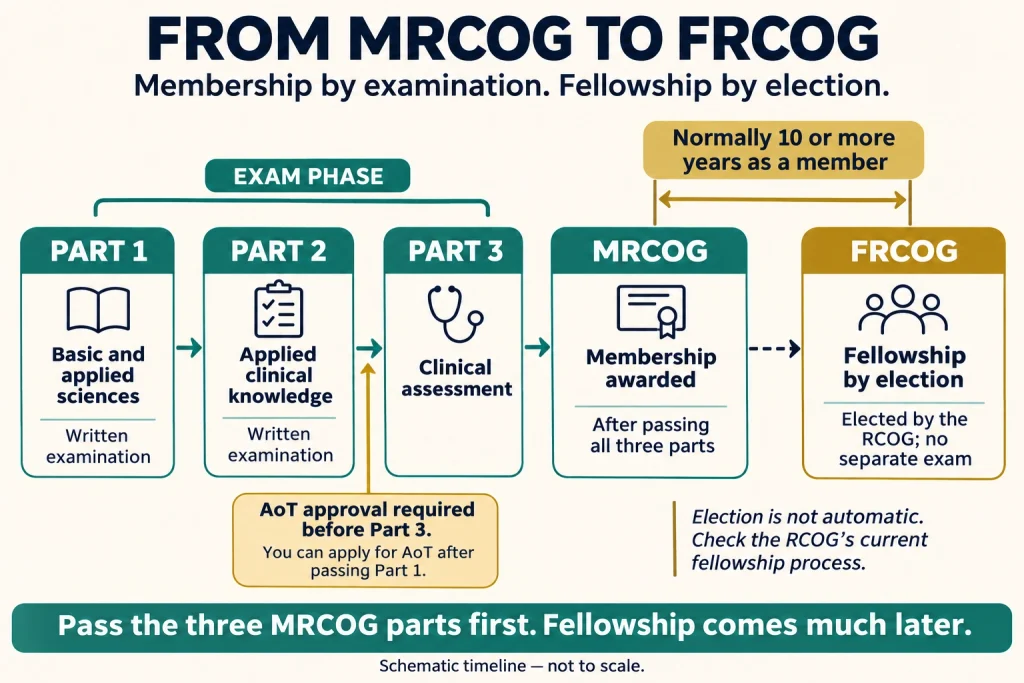
Because fellowship is for members, the path between MRCOG and FRCOG always runs through the exams. There is no shortcut and no separate entrance exam.
The timeline from MRCOG to FRCOG
The MRCOG and FRCOG journey is best seen as one long timeline with an exam phase and a career phase. The table shows the stages and the rules we can confirm.
| Stage | What happens | Rule to know |
|---|---|---|
| Part 1 | Eligibility check, then an Expression of Interest each sitting | First-time candidates prove their primary medical degree |
| Part 2 | Sit after passing Part 1 | Attempt within 10 years of passing Part 1 (7 years pro rata on the UK Specialist Register route) |
| Assessment of Training | Apply any time after passing Part 1 | Must be approved before Part 3 |
| Part 3 | 14-task clinical assessment | 4 attempts; attempt within 7 years (pro rata) of passing Part 2 |
| Membership | Award of MRCOG | Keep practising and contributing as a member |
| Fellowship | Election to FRCOG | Normally after 10 or more years as a member |
Part 1 and Part 2 have no attempt limit unless you are on the UK Specialist Register route, where the maximum is 6. Part 3 allows 4 attempts for everyone; after 4 unsuccessful attempts you retake Part 2. In the MRCOG vs FRCOG timeline, these limits belong only to the exam phase, so they deserve your attention early.
Preparation tips for MRCOG, part by part
Your MRCOG vs FRCOG planning should start with the exams, because they are the only part you can actively prepare for. Each part rewards a different kind of work.
Part 1. It tests basic and applied sciences through single best answer questions, so build steady question practice over months, not weeks. Work through the RCOG Part 1 syllabus and keep an error log. Our MRCOG Part 1 course is built around that approach.
Part 2. This is about applying knowledge to clinical scenarios across SBAs and EMQs, and guidelines matter. Make the RCOG Green-top Guidelines a core text, and practise timing: the RCOG suggests about 70 minutes for SBAs and 110 for EMQs per paper.
Part 3. Fourteen 12-minute tasks test five domains, from patient safety to applied clinical knowledge. Rehearse full circuits aloud with timed reading, and get feedback by domain rather than by topic. Apply for your Assessment of Training early; the RCOG advises allowing 4 weeks after the deadline for processing.
Preparing for FRCOG over your career
You don’t revise for FRCOG; you build a career the College recognises. In the MRCOG vs FRCOG picture, this phase lasts far longer than the exam years.
Stay a member, keep practising, and read the RCOG’s current fellowship guidance early so you know what it looks at. Beyond that, the right steps depend on your role and country, and we won’t invent criteria the College does not publish.
A practical habit helps: keep a running record of your roles and professional activities through the years. When the time comes, you will be glad not to reconstruct a decade from memory. Be wary of any MRCOG vs FRCOG “fast track” you see advertised, since fellowship normally follows 10 or more years of membership.
How to choose your focus by career stage
Since the MRCOG vs FRCOG question is about sequence, the real choice is where to put your energy now.
If you are an MBBS graduate or junior doctor, focus entirely on MRCOG Part 1. Fellowship normally comes a decade or more after membership, so it should not shape your study plan today.
If you have passed Part 1 or Part 2, your priority is the next part and your Assessment of Training. Check the time limits so a gap between parts doesn’t catch you out.
If you are a member, concentrate on your clinical career and read the RCOG’s fellowship guidance. After normally 10 or more years of membership, fellowship becomes a realistic next step.
Comparing MRCOG with other qualifications too? See MRCOG vs DNB, MRCOG vs DRCOG and MRCOG vs international exams.
Frequently asked questions
Is there an FRCOG exam?
No. FRCOG is a fellowship the RCOG elects members to, normally after 10 or more years as a member; it is not an exam.
Is FRCOG higher than MRCOG?
Fellowship is the more senior title, but the MRCOG vs FRCOG comparison is about stage, not rank alone. You must be a member first, so MRCOG always comes before FRCOG.
Can I get FRCOG without MRCOG?
No. Fellowship is for members of the College, and membership is earned by passing all three exam parts, so the MRCOG and FRCOG order never changes.
How long after MRCOG can I become FRCOG?
Normally after 10 or more years as a member, which makes the MRCOG vs FRCOG gap normally a decade or more. Check the RCOG website for the current process.
What should I focus on first, MRCOG and FRCOG together?
Focus on MRCOG alone. Fellowship comes much later, so put your effort into Part 1, Part 2 and Part 3 now.
Does FRCOG change my licence in the UK or the UAE?
We can only confirm how MRCOG is recognised: on the GMC list in the UK and under the Unified PQR in the UAE. For anything fellowship-specific, ask the relevant regulator.
Planning your route to membership? Talk to our MRCOG team about where you are now and which part to start with.
Related guides:
- What is MRCOG?
- MRCOG vs DNB: which suits your career?
- MRCOG vs DRCOG: which one suits you?
- MRCOG vs international exams
Sources: