
The MRCOG vs international exams question has one honest answer: pick the qualification built for the country where you want to work. MRCOG suits doctors aiming for the UK or the UAE, or who want an exam they can sit from many countries without a local residency, while routes such as DNB, FRANZCOG or ABOG make most sense if you intend to settle in India, Australia and New Zealand, or the US.
This guide covers what each route is, where MRCOG’s recognition is confirmed, and how to choose by your destination.
Table of Contents
MRCOG vs international exams at a glance
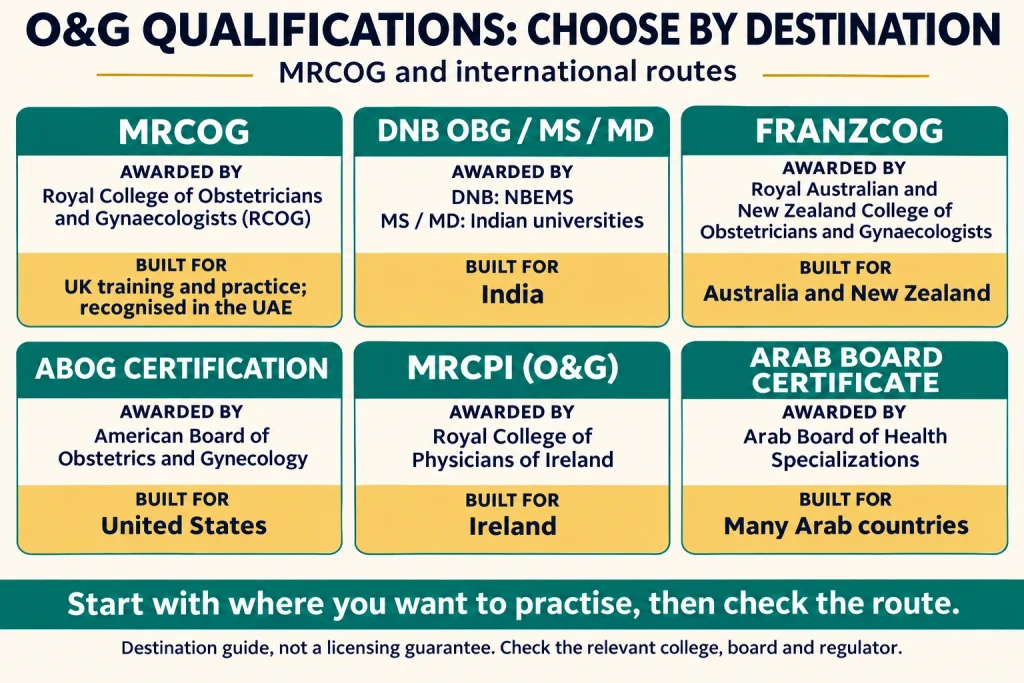
Every major O&G qualification is tied to a health system, and that tie matters more than any league table. The MRCOG vs international exams table below shows where each route is designed to take you.
| Qualification | Awarding body | Built mainly for | What to check |
|---|---|---|---|
| MRCOG | Royal College of Obstetricians and Gynaecologists, UK | UK training and practice; recognised in the UAE | Confirmed details below |
| DNB OBG | NBEMS, India | Indian hospitals and medical colleges | NBEMS bulletin |
| MS or MD OBG | Indian universities | Indian practice and teaching | NMC and university rules |
| FRANZCOG | Royal Australian and New Zealand College of Obstetricians and Gynaecologists | Australia and New Zealand | The college’s own website |
| ABOG certification | American Board of Obstetrics and Gynecology | The United States | The board’s own website |
| Arab Board certificate | Arab Board of Health Specializations | Many Arab countries | The board’s own website |
| MRCPI (O&G) | Royal College of Physicians of Ireland | Ireland | The college’s own website |
We describe the non-RCOG routes in plain terms only. For their current rules, dates and fees, always go to each body’s own site.
MRCOG: the exam-led route that travels
MRCOG stands out among overseas exams because you can sit Parts 1 and 2 without moving countries or joining a local residency first. That flexibility is why it features in almost every MRCOG vs international exams discussion among Indian and Gulf doctors.
The structure is three parts. Part 1 is two computer-based papers of 100 single best answer questions, 2.5 hours each; Part 2 is two papers of 50 SBAs and 50 EMQs, 3 hours each. Both are taken at Pearson VUE centres. Part 3 is a 14-task clinical assessment held in May and November, with recent centres including London, Kolkata, Mumbai, Cairo, Abu Dhabi, Hong Kong and Malaysia.
To start, you only need a verified primary medical degree. Part 3 requires an approved Assessment of Training; outside UK training, Route B asks for 4 years full-time equivalent in O&G posts after registration, 2 of them within the last 4 years. Read what MRCOG is for the full picture, or see our MRCOG Part 1 course if you are ready to begin.
What MRCOG costs in 2027. The fee band follows your exam centre, not where you live, which is worth knowing when you compare costs across overseas exams.
| Band | Example centres | Part 1 or Part 2 | Part 3 |
|---|---|---|---|
| UK and Ireland | UK, Ireland | £589 | £645 |
| Band A | UAE, Qatar, Saudi Arabia, Oman, Kuwait, Bahrain, Malaysia | £710 | £1,034 |
| Band B | India, Pakistan, Egypt, Sri Lanka, Bangladesh, Nepal, Nigeria | £613 | £964 |
GST applies to Part 1 and Part 2 fees for exams sat in India, so check the total at checkout. See the RCOG country bandings for the full list.
Indian routes: DNB and MS
If India is your long-term base, the MRCOG vs international exams question changes shape: a national postgraduate degree is the foundation, and MRCOG sits alongside it rather than replacing it.
DNB OBG is a 3-year residency entered through NEET-PG. The final exam has 4 theory papers of 100 marks, each with 10 short-answer questions, plus a practical with long and short cases, OSCE, spots and viva, and a thesis is required. MS and MD are university degrees that fill the same role in Indian practice.
The NMC treats MRCOG as valid but not equivalent to MD or MS. For medical-college faculty posts, UK qualifications count only with CCT or CCST plus UK specialist registration. Our detailed MRCOG vs DNB comparison covers this choice step by step.
Other overseas exams in brief
These overseas exams are each built for a particular country or region, and a one-line description is the fair way to compare them here.
FRANZCOG is the fellowship of the Royal Australian and New Zealand College of Obstetricians and Gynaecologists, the specialist O&G qualification for those two countries. ABOG certification is specialty board certification in obstetrics and gynaecology in the United States. The Arab Board certificate in O&G comes from the Arab Board of Health Specializations and is used across many Arab countries. MRCPI in O&G is the Irish membership route from the Royal College of Physicians of Ireland.
Each has its own eligibility, training and residency expectations, which can change. Check the body’s official website before you plan around any of them, and treat second-hand summaries, including ours, as a starting point only. Comparing overseas exams on reputation alone misses the point, because where you will be licensed matters far more.
Where MRCOG recognition is confirmed
In any MRCOG vs international exams decision, recognition is the deciding factor, so here is exactly what we can confirm.
| Country | Confirmed position |
|---|---|
| UK | Full MRCOG is on the GMC list of acceptable postgraduate qualifications (awarded within the last 3 years). UK trainees pass Part 1 by ST3 and Parts 2 and 3 by ST6. |
| UAE | The Unified Professional Qualification Requirements recognise exam-based UK Royal College membership; Specialist or Consultant grade depends on experience. |
| India | Valid, but not equivalent to MD or MS under the NMC. |
| Qatar, Saudi Arabia, Oman | Check the regulator’s current requirements: DHP Qatar, SCFHS, OMSB. |
Completing MRCOG leads to the award of membership. It does not by itself make you a specialist or consultant anywhere, so the licence you receive still depends on the local regulator and your experience, whichever side of the MRCOG vs international exams choice you land on.
How to choose by where you want to work
Start with the country, then pick the exam: that one rule settles most MRCOG vs international exams dilemmas.
You want to work in the UK. MRCOG is the specialty exam UK trainees sit, and it is on the GMC list once complete, if awarded within the last 3 years.
You want to work in the UAE. MRCOG fits the Unified PQR, with your grade set by experience. Build your O&G posts alongside the exams so you also meet Part 3’s training requirement.
You want to settle in India. Secure DNB, MS or MD first. Add MRCOG if you want international options later, knowing it won’t replace an Indian degree for faculty posts.
You want Australia, New Zealand, the US or Ireland. Look first at FRANZCOG, ABOG or MRCPI respectively, and check each body’s rules for doctors trained elsewhere.
You are not sure yet. MRCOG keeps the most doors open while you decide, because Parts 1 and 2 can be sat from many countries. If you lack O&G posts, StudyMEDIC’s two-year Clinical Program combines hospital training with preparation.
Related comparisons worth reading: MRCOG vs DRCOG and MRCOG vs FRCOG.
Frequently asked questions
Which is better, MRCOG or FRANZCOG?
Neither is better in general. In the MRCOG vs international exams comparison, MRCOG suits the UK and UAE, while FRANZCOG is built for Australia and New Zealand; choose by where you want to practise.
Can I sit MRCOG from India or the Gulf?
Yes. Parts 1 and 2 are held at Pearson VUE centres, and Part 3 has run in Mumbai, Kolkata and Abu Dhabi among other centres.
Is MRCOG recognised in Saudi Arabia, Qatar or Oman?
We can’t confirm a current position for those countries. Check the regulator’s own requirements before you rely on MRCOG there.
Do other overseas exams accept MRCOG parts as exemptions?
Check each body’s own rules. MRCOG itself has no exemptions, so every candidate sits all three parts.
Is MRCOG enough to practise as a gynaecologist in India?
It is valid, but the NMC does not treat it as equivalent to MD or MS. Many doctors planning an Indian career hold a national degree as well, then weigh MRCOG vs international exams only if they want to work abroad.
How do I start MRCOG?
Submit the Part 1 eligibility application with proof of your primary medical degree, then register an Expression of Interest for the sitting you want.
Weighing up your options? Talk to our MRCOG team about where you want to work and which route fits.
Related guides:
- What is MRCOG?
- MRCOG vs DNB: which suits your career?
- MRCOG vs DRCOG: which one suits you?
- MRCOG vs FRCOG: the difference explained
Sources: