
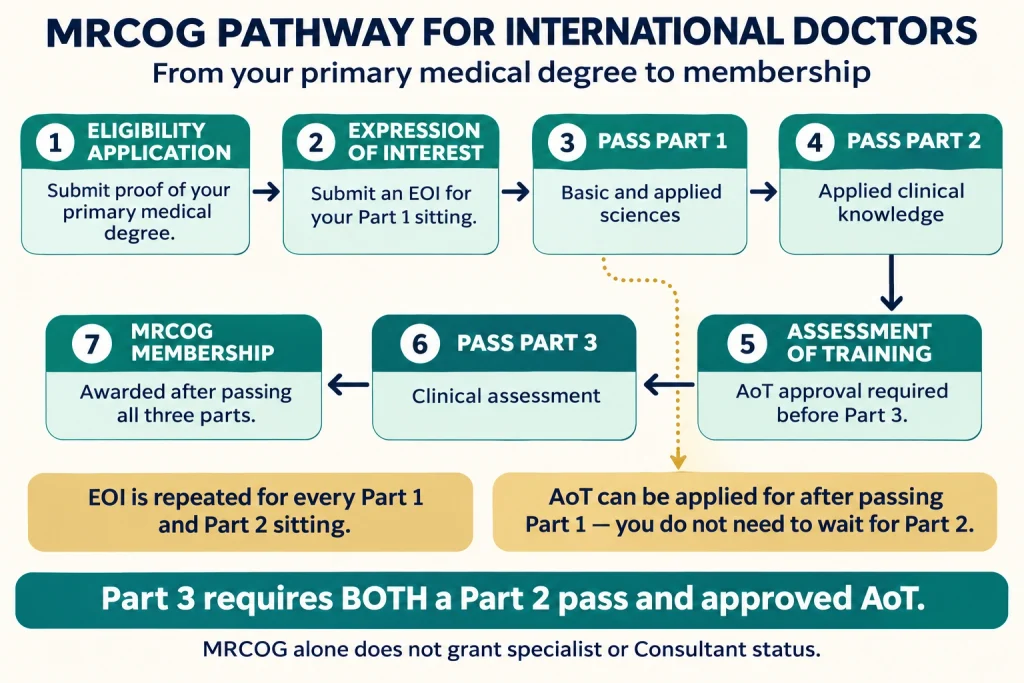
MRCOG for international doctors starts with one simple requirement: proof of your primary medical degree, which means you can begin Part 1 without any UK experience. From there you follow the same three parts as UK trainees, with two extra things to plan for: the fee band of your exam centre and, before Part 3, an approved Assessment of Training.
This guide covers how the exam works for international medical graduates: eligibility and document certification, expressions of interest, 2027 fees by band, exam centres, the AoT route for doctors outside UK training, attempt limits and what the qualification can and cannot do for your career.
Table of Contents
Who can take MRCOG for international doctors
Any doctor with a primary medical degree can apply for Part 1, wherever they qualified. As a first-time candidate you submit an eligibility application with proof of that degree, either an original or attested copy of your degree certificate, or a registration certificate that states your degree and university.
Certification is where many international medical graduates lose time. The copy must be certified by a notary public, a commissioner of oaths, a justice of the peace, a lawyer, or an embassy or consulate officer. A relative cannot certify it, and neither can you, and any document not in English needs a translation.
Start this early, because for international medical graduates a rejected document can push you back a whole sitting, so check the RCOG Part 1 FAQs before you send anything. For a wider introduction to the exam, read our guide on what is MRCOG.
Expressions of interest and booking each sitting
Once you are eligible, you submit an Expression of Interest (EOI) for every sitting you want to take, for Part 1 and again for Part 2. Eligibility is a one-time step; the EOI is not, so missing its deadline means waiting for the next sitting.
The table shows the confirmed Part 1 dates for 2027. Part 2 runs on the same EOI and booking windows, with the exam the day after Part 1.
| Part 1 sitting | EOI deadline | Booking window | Exam | Results |
|---|---|---|---|---|
| January 2027 | Fri 2 Oct 2026 | Tue 27 Oct to Tue 15 Dec 2026 | Tue 19 Jan 2027 | Wed 17 Feb 2027 |
| July 2027 | Tue 30 Mar 2027 | Tue 20 Apr to Tue 15 Jun 2027 | Tue 13 Jul 2027 | Wed 11 Aug 2027 |
For the July 2027 sitting, first-time candidates also face an eligibility deadline of Tue 16 Mar 2027. Our MRCOG Part 1 and Part 2 booking dates guide is kept up to date for each sitting.
Fees for international medical graduates by band
Your fee depends on the band of the country where you sit the exam, not where you live or trained. That matters for MRCOG for international doctors who move between countries, because sitting in a different centre can change the price.
| Band | Example countries | Part 1 or Part 2 (2027) | Part 3 (2027) |
|---|---|---|---|
| UK & Ireland | UK, Ireland | £589 | £645 |
| Band A | UAE, Qatar, Saudi Arabia, Oman, Kuwait, Bahrain, Malaysia | £710 | £1,034 |
| Band B | India, Pakistan, Egypt, Sri Lanka, Bangladesh, Nepal, Nigeria | £613 | £964 |
| Band C | See RCOG list | £489 | £707 |
If you sit Part 1 or Part 2 in India, GST has applied to these fees since January 2025, and the amount is not published separately, so check the total at checkout. Part 3 fees are not affected. The full list of countries is on the RCOG country bandings page.
Where international candidates sit each part
Parts 1 and 2 are computer-based and taken at Pearson VUE test centres, so most international medical graduates can sit them in or near their home country. Part 3 is a clinical assessment held in May and November at a smaller set of centres.
For the November 2026 Part 3, the centres are London, Kolkata, Mumbai, Malaysia, Cairo, Abu Dhabi and Hong Kong, with results on Wed 9 Dec 2026. Centres can change between sittings, so confirm the list on the RCOG key dates page each time. Our MRCOG Part 3 booking dates guide tracks the windows for May and November 2027.
Part 3 and the AoT route for overseas doctors
To sit Part 3 you must pass Part 2 and have your Assessment of Training (AoT) approved. This is the step that most shapes MRCOG for international doctors, because Route A is for UK trainees at ST3 or above, while most doctors outside UK training apply through Route B.
Route B asks for 4 years of full-time-equivalent posts in obstetrics and gynaecology after registration, with 2 of those years falling within the last 4 years. You can apply for AoT any time after passing Part 1, and the RCOG advises allowing 4 weeks after its deadline for processing. For May 2027 the AoT deadline is Thu 21 Jan 2027, and for November 2027 it is Thu 22 Jul 2027.
If you are short of O&G posts, plan that gap now rather than after Part 2. StudyMEDIC’s two-year Clinical Program offers hospital-based O&G experience for doctors in that position, though you should confirm with the RCOG how any post counts towards Route B. Our guide to MRCOG Part 3 eligibility explains the documents in more detail.
Attempt limits and time rules
Attempt limits are generous for most international medical graduates, but the time rules between parts are strict. Plan your sittings so you never run up against them.
| Rule | What applies |
|---|---|
| Part 1 and Part 2 attempts | No limit, unless you are on the UK Specialist Register route (maximum 6) |
| Part 3 attempts | 4 for everyone; after 4 unsuccessful attempts you retake Part 2 |
| Part 1 to Part 2 | Attempt Part 2 within 10 years of passing Part 1 (7 years pro rata on the UK Specialist Register route) |
| Part 2 to Part 3 | Attempt Part 3 within 7 years (pro rata) of passing Part 2 |
| Missing Part 3 | Not counted as an attempt, but the fee is generally forfeited |
The 7-year window is the one international medical graduates most often underestimate, especially when the AoT needs extra O&G posts. Counting back from it tells you how quickly you need to build your clinical experience.
Career scope of MRCOG for international doctors
The career value depends on the country where you want to work, because each regulator decides what the qualification counts for. Completing all three parts leads to the award of MRCOG, but it does not by itself make you a specialist or consultant anywhere.
In the UK, full MRCOG is on the GMC list of acceptable postgraduate qualifications when awarded within the last 3 years. In the UAE, the Unified Professional Qualification Requirements recognise exam-based UK Royal College membership, and whether you are licensed as Specialist or Consultant depends on your experience; see the Ministry of Health and Prevention. In India, MRCOG is valid but not equivalent to MD or MS under the NMC, and for Qatar, Saudi Arabia and Oman you should check each regulator’s current requirements.
For a country-by-country view of MRCOG for international doctors, read our guide to career after MRCOG.
Frequently asked questions
Do I need UK experience to sit Part 1?
No. MRCOG for international doctors begins with proof of your primary medical degree, certified by an approved person, and an EOI for each sitting.
Who can certify my degree certificate?
A notary public, commissioner of oaths, justice of the peace, lawyer, or embassy or consulate officer. A relative or you yourself cannot certify it.
Which fee band applies to MRCOG for international doctors?
The band of the country where you sit the exam. India is Band B and the GCC countries are Band A, whatever your nationality.
How do international medical graduates qualify for Part 3?
You must pass Part 2 and have AoT approved, usually through Route B: 4 years of full-time-equivalent O&G posts after registration, 2 of them within the last 4 years.
How many attempts do I get?
Part 1 and Part 2 have no attempt limit unless you are on the UK Specialist Register route. Part 3 allows 4 attempts, after which you retake Part 2.
Does MRCOG make me a specialist in my country?
Not by itself. Your licence grade is set by the local regulator, so check its current requirements before you plan a move.
Talk to our MRCOG team for help planning your sittings, or start with our MRCOG Part 1 course.
Related guides:
- What is MRCOG? Eligibility, parts and recognition
- MRCOG Part 1 and Part 2 booking dates
- MRCOG Part 3 eligibility explained
- Career after MRCOG
Sources: