
The benefits of MRCOG are real but specific: it is a demanding, guideline-based qualification in obstetrics and gynaecology that is formally recognised in some systems, such as the UK and UAE, and treated differently in others, such as India. It sharpens how you practise and it carries weight with employers who know the RCOG, but it does not on its own make you a specialist or a consultant anywhere. Knowing exactly what it does and does not do is the best way to decide whether it is worth years of your effort.
This guide covers what MRCOG gives you, where its recognition is confirmed, how it changes your clinical work, its practical flexibility for working doctors, and an honest list of its limits.
Table of Contents
What are the benefits of MRCOG?
In short, MRCOG gives you a recognised postgraduate qualification, a structured way to learn modern O&G practice, and a membership that some regulators accept as part of their licensing rules. It is awarded once you pass all three parts, and there are no exemptions, so every member has completed the same assessment. If you are new to the exam, our guide on what MRCOG is explains the structure first.
The table summarises the main benefits of MRCOG alongside the honest limit that goes with each.
| Benefit | What it means in practice | The limit to keep in mind |
|---|---|---|
| UK recognition | Full MRCOG is on the GMC list of acceptable postgraduate qualifications | Applies if awarded within the last 3 years |
| UAE recognition | The Unified PQR recognises exam-based UK Royal College membership | Specialist or Consultant grade depends on experience |
| India | MRCOG is a valid qualification | Not equivalent to MD/MS under the NMC |
| Clinical standards | Training built around current guidelines and patient safety | Knowledge still needs supervised practice |
| Professional standing | Membership of the RCOG | FRCOG is a separate, later election |
Where MRCOG recognition is confirmed
The clearest benefits of MRCOG appear where a regulator has written it into its rules. In three places the position is confirmed, and in the rest you should check the current requirements yourself before you plan around it.
United Kingdom. Full MRCOG is on the GMC list of acceptable postgraduate qualifications when it has been awarded within the last three years. For UK trainees the exam is also part of training itself: Part 1 is expected by ST3, and Parts 2 and 3 by ST6.
United Arab Emirates. The Unified Professional Qualification Requirements (PQR), published through the Ministry of Health and Prevention, recognise exam-based UK Royal College membership. Whether you are then licensed as a Specialist or a Consultant depends on your experience, not on the qualification alone.
India. MRCOG is valid, but the NMC does not treat it as equivalent to MD/MS. For medical-college faculty posts, UK qualifications count only with CCT/CCST plus UK specialist registration. If you are weighing it against a domestic route, our comparison of MRCOG vs DNB sets out the trade-offs.
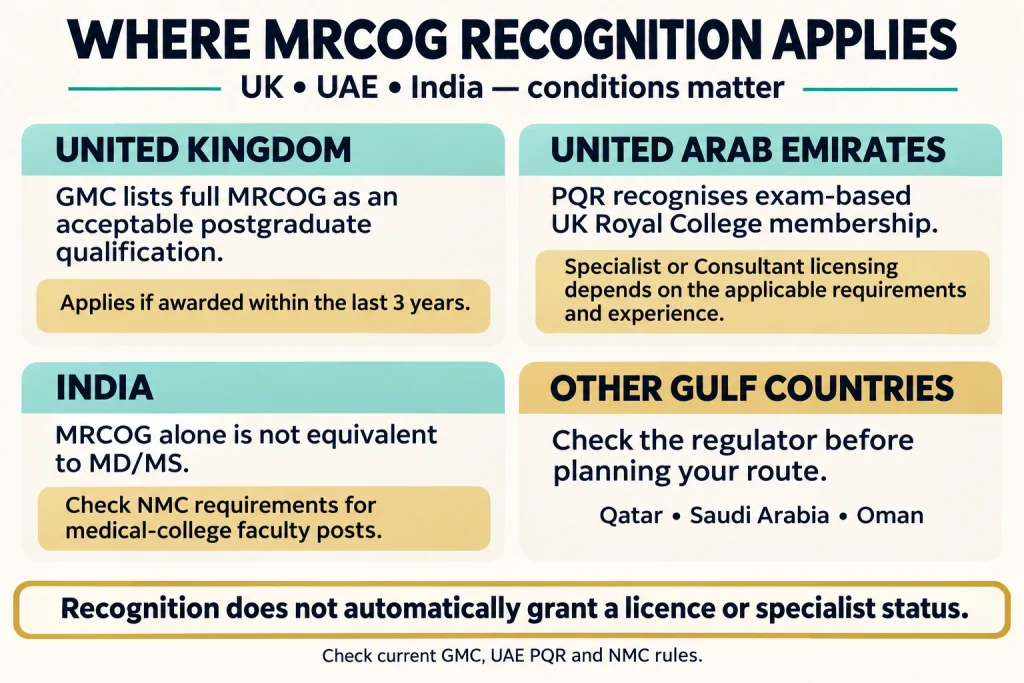
Qatar, Saudi Arabia and Oman. We have not been able to confirm how each regulator currently treats MRCOG membership, so check the regulator’s current requirements before you apply. Rules for licensing grade and experience change, and the regulator’s own page is the only safe source.
Benefits of MRCOG for your clinical practice
The most underrated benefit is what the preparation does to your everyday work. Part 1 builds the basic science behind obstetrics and gynaecology, Part 2 drills you in applying current guidance, and Part 3 tests how you handle real clinical conversations.
Preparing for Part 2 means working closely with the RCOG Green-top Guidelines and with NICE, BASHH and FSRH guidance. Once you have done that work, you will probably find yourself quoting guidelines more confidently on the ward and explaining decisions more clearly to colleagues.
Part 3 is where the clinical benefits of MRCOG are most obvious. Its 14 tasks assess five domains: patient safety, communication with patients and relatives, communication with colleagues, information gathering, and applied clinical knowledge. Practising those tasks, from breaking difficult news to leading a handover, improves skills that matter in every consultation, whether or not anyone is marking you.
Practical flexibility for working doctors
MRCOG is built to be sat by doctors around the world, and that flexibility is one of the practical benefits of MRCOG. Parts 1 and 2 are computer-based and taken at Pearson VUE centres, and Part 3 runs in May and November. The November 2026 sitting is held in London, Mumbai, Kolkata, Abu Dhabi, Cairo, Hong Kong and Malaysia.
Fees are banded by the country of the exam centre, not where you live. The 2027 fees are below; see the RCOG country bandings for the full list.
| Band | Example countries | Part 1 / Part 2 | Part 3 |
|---|---|---|---|
| UK & Ireland | UK, Ireland | £589 | £645 |
| Band A | UAE, Qatar, Saudi Arabia, Oman, Kuwait, Bahrain, Malaysia | £710 | £1,034 |
| Band B | India, Pakistan, Egypt, Sri Lanka, Bangladesh, Nepal, Nigeria | £613 | £964 |
| Band C | Other band C countries | £489 | £707 |
For exams sat in India, GST has applied to Part 1 and Part 2 fees since January 2025, so check the total at checkout. Attempts are also generous for most candidates. Part 1 and Part 2 are limited to six attempts only on the UK Specialist Register route, with no limit otherwise, while Part 3 allows four attempts for everyone.
Professional standing and the route to FRCOG
MRCOG membership connects you to the RCOG and to a qualification that colleagues and employers in O&G know by name. That recognition among peers is hard to measure, yet it is one of the benefits of MRCOG doctors mention most when they look back.
MRCOG membership is also the first step towards Fellowship. FRCOG is not an exam: Fellows are elected, normally after ten or more years as a member. Our guide on MRCOG vs FRCOG explains the difference.
What MRCOG does not do
Being honest about the limits is part of judging the benefits of MRCOG fairly. Here is what the qualification will not do for you on its own:
- It does not make you a specialist or consultant. Completing all three parts leads to the award of MRCOG, not to specialist or consultant status.
- It is not MD/MS in India. The NMC position is clear that it is not equivalent.
- It does not license you automatically. Every regulator applies its own rules on experience and grade.
- It does not guarantee a job or a salary. Pay depends on country, licence grade, experience and sector, as our guide to MRCOG salary explains.
None of these limits cancels out the benefits of MRCOG. They simply mean you should plan your licensing and job search alongside the exam, not after it.
Is MRCOG worth it for you?
Whether the benefits of MRCOG outweigh the cost depends mostly on where you want to work. Match your goal to the table, then read the regulator’s page for that country.
| Your goal | How MRCOG helps | What else you will need |
|---|---|---|
| Work in the UK | GMC acceptable qualification, part of UK training | GMC registration and a suitable post |
| Work in the UAE | Recognised under the Unified PQR | Experience that fits the grade you want |
| Practise in India | Valid qualification, strong clinical training | MD/MS or the faculty rule if you want academic posts |
| Work in Qatar, Saudi Arabia or Oman | A known O&G qualification | Check the regulator’s current requirements |
If you are an international graduate planning several of these steps, our guide to MRCOG for international doctors covers eligibility and the pathway in detail. You can also compare it with other routes in MRCOG vs international exams.
Frequently asked questions
What are the main benefits of MRCOG?
It gives you a recognised O&G qualification, guideline-based clinical training, and RCOG membership. Its formal value depends on the regulator in the country where you want to work.
Is MRCOG recognised by the GMC?
Yes. Full MRCOG membership is on the GMC list of acceptable postgraduate qualifications when awarded within the last three years.
Is MRCOG equivalent to MD or MS in India?
No. MRCOG is valid in India, but the NMC does not treat it as equivalent to MD/MS.
Does MRCOG membership make me a consultant?
No. Completing the three parts leads to the award of MRCOG, not to specialist or consultant status. In the UAE, for example, your licensing grade depends on experience.
Is MRCOG recognised in Qatar, Saudi Arabia or Oman?
We cannot confirm the current position, so check the regulator’s current requirements before you plan around it.
Can I sit MRCOG without leaving my country?
Often, yes. Parts 1 and 2 are taken at Pearson VUE centres, and Part 3 runs in several cities, including Mumbai, Kolkata and Abu Dhabi.
Talk to our MRCOG team about which part to start with, or explore the MRCOG Part 1 course.
Related guides:
Sources: