
Good MRCOG Part 3 preparation is mostly spoken, timed practice rather than more reading. Get your Assessment of Training (AoT) approved early, understand how the 14-task circuit works, then give yourself around 12 weeks of rehearsing tasks out loud with a partner and a clock.
This guide covers the admin steps, a 12-week timetable, how to rehearse each task type, the communication and safety habits that carry across tasks, the final fortnight and the mistakes we see most often.
Table of Contents
What your preparation is really training
MRCOG Part 3 preparation trains behaviour, not recall, because the exam watches what you do with knowledge you already proved in Part 2. The circuit has 14 tasks of 12 minutes each, including 2 minutes’ reading, and every task is based on one of the 14 syllabus modules.
You will meet two kinds of task. In simulated patient or colleague tasks you talk to a trained role-player; in structured discussion tasks you talk directly with a clinical examiner. Each task assesses three or four of five domains: patient safety, communication with patients and relatives, communication with colleagues, information gathering and applied clinical knowledge.
That is all the format you need to start planning. If you want the detail on examiners, sittings and centres, read our MRCOG Part 3 exam format guide first and come back here.
Step by step: from AoT approval to exam day
The first steps of the Part 3 exam journey are administrative, and a missed deadline costs you a whole sitting. Work through them in this order.
- Confirm you are eligible. You need a Part 2 pass and an approved AoT. Our MRCOG Part 3 eligibility guide explains Routes A and B and the evidence to gather.
- Apply for AoT early. You can apply any time after passing Part 1, and the RCOG asks you to allow 4 weeks after its advised deadline for processing.
- Choose your sitting. Part 3 runs in May and November, so pick the one that leaves you 12 clear weeks of practice.
- Book as soon as your window opens. Booking windows are short; our MRCOG Part 3 booking dates page is updated every sitting.
- Take a baseline. Do three or four timed tasks with a colleague watching and write down which domains you lost.
- Start the timetable, then sit two or three full mock circuits in the last six weeks, the final one before the last fortnight.
If you are aiming for May 2027, working back from the RCOG’s published dates gives a clear shape to your MRCOG Part 3 preparation.
| When | What to do |
|---|---|
| By Thu 21 Jan 2027 | AoT deadline for the May 2027 sitting |
| Early February 2027 | Week 1 of your 12-week plan begins |
| Thu 4 to Mon 8 Mar 2027 | First booking window |
| Thu 11 to Mon 15 Mar 2027 | Second booking window |
| Mid April 2027 | Full mock circuit and targeted repair |
| 5, 6, 10 and 11 May 2027 | Exam days |
| Wed 9 Jun 2027 | Results |
A 12-week MRCOG Part 3 preparation timetable
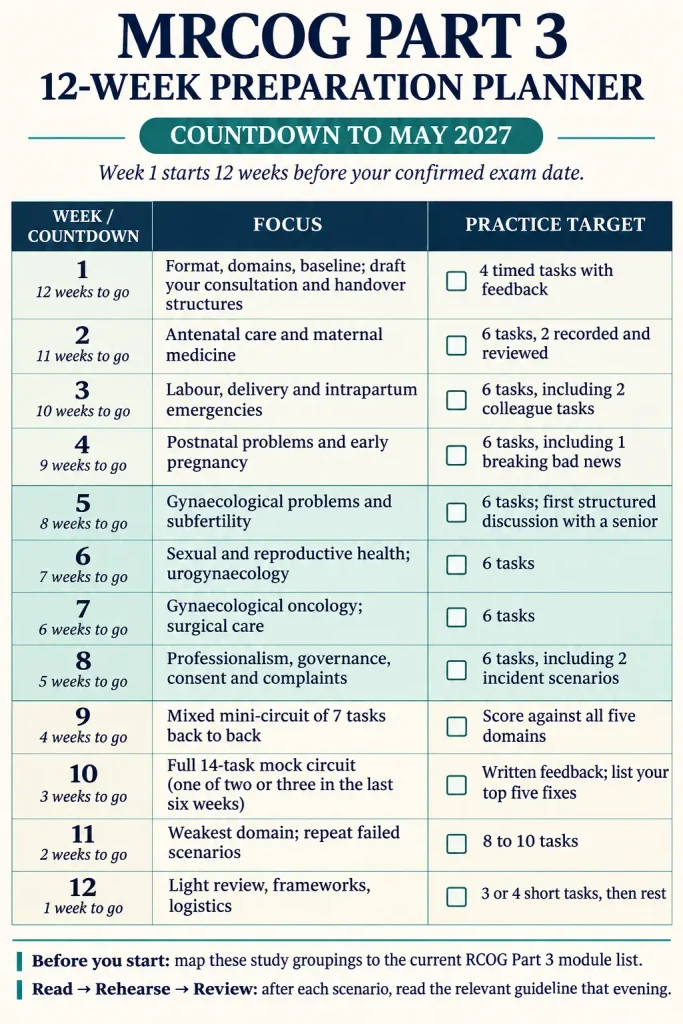
This timetable works best when the first eight weeks cover every module and the last four switch to mixed, timed circuits. It assumes roughly 10 to 12 hours a week alongside clinical work.
| Week | Focus | Practice target |
|---|---|---|
| 1 | Format, domains, baseline; draft your consultation and handover structures | 4 timed tasks with feedback |
| 2 | Antenatal care and maternal medicine | 6 tasks, 2 recorded and reviewed |
| 3 | Labour, delivery and intrapartum emergencies | 6 tasks, including 2 colleague tasks |
| 4 | Postnatal problems and early pregnancy | 6 tasks, including 1 breaking bad news |
| 5 | Gynaecological problems and subfertility | 6 tasks; first structured discussion with a senior |
| 6 | Sexual and reproductive health; urogynaecology | 6 tasks |
| 7 | Gynaecological oncology; surgical care | 6 tasks |
| 8 | Professionalism, governance, consent and complaints | 6 tasks, including 2 incident scenarios |
| 9 | Mixed mini-circuit of 7 tasks back to back | Score against all five domains |
| 10 | Full 14-task mock circuit (one of two or three in the last six weeks) | Written feedback; list your top five fixes |
| 11 | Weakest domain; repeat failed scenarios | 8 to 10 tasks |
| 12 | Light review, frameworks, logistics | 3 or 4 short tasks, then rest |
These groupings are ours, so map them to the current module list on the RCOG Part 3 pages before you start. Tie reading to rehearsal: when you practise a scenario, read the relevant guideline that evening. Our guide to mastering Green-top, NICE, BASHH and FSRH guidelines shows how to keep that reading focused.
How to rehearse each task type in the Part 3 exam
Each task type in the Part 3 exam needs its own rehearsal method, and all of them need a clock: 2 minutes to read, 10 minutes to deliver.
Simulated patient tasks. Work in threes: candidate, role-player and observer with a domain checklist. Give the role-player a hidden concern, a refusal or an emotional cue so you practise finding it rather than being handed it. Record some sessions; jargon and interruptions are obvious on playback and invisible in the moment.
Simulated colleague tasks. Rehearse the conversations that feel awkward on the ward: a junior who made an error, a midwife who disagrees with your plan, a call to a consultant at 3 am. Be specific about who does what next and by when.
Structured discussion tasks. Ask a senior to play the examiner with a list of prompts and to change the scenario halfway through. Answer in a steady order (immediate safety, assessment, investigations, options, follow-up) and say your reasoning aloud, because silent reasoning earns nothing.
Leave the last minute of every practice task for a summary and safety-net. If you overrun at home, you will overrun on the day.
Communication and safety habits that score across domains
The habits that score in one domain usually score in several, so build a few simple structures into your MRCOG Part 3 preparation and use them every time. None of them is required by the RCOG; they simply keep you organised when you are nervous.
For a consultation, introduce yourself, agree the agenda, explore the patient’s ideas, concerns and expectations, explain in plain language, share the decision, check understanding and safety-net. Breaking bad news adds a warning shot, small chunks of information and real pauses. With colleagues, give the situation, background, your assessment and a clear request, then confirm the plan back.
Patient safety is a named domain, so say the safe step out loud even when it feels obvious. Ask yourself in every task whether anyone is unsafe right now and what must happen first. Mention escalation, consent and capacity, safeguarding where relevant, documentation and incident reporting, and close with what should bring the patient back.
The final fortnight and exam day
In the last two weeks, stop learning new material and protect your sleep. Strong MRCOG Part 3 preparation ends with a taper: a handful of short tasks, a re-read of your frameworks and safety points, and confirmed travel to your centre.
On the day, use the 2 minutes of reading fully. Identify what the task wants you to achieve, the key clinical or ethical issue and the safety point, then jot a three or four line plan. Communicate the way you do on a good ward round: calm voice, open questions, check understanding.
Expect at least one task to go badly. One poor task does not decide the Part 3 exam, so leave it at the door before the next bell.
Mistakes that cost candidates marks
Most lost marks come from behaviour rather than knowledge gaps. These are the patterns we see most often in MRCOG Part 3 preparation:
- Reading guidelines for weeks instead of rehearsing out loud
- Answering the case you expected rather than the instructions in front of you
- Closed questions and jargon that hide the patient’s real concern
- No escalation or safety-net, which costs patient-safety marks
- Running out of time before the summary
- Leaving AoT and booking until the last minute
Mocks are the best way to catch these early. Our article on how mock exams can transform your Part 3 preparation explains how to run a home circuit and use the feedback.
Frequently asked questions
How long should MRCOG Part 3 preparation take?
Many candidates plan for about 12 weeks of focused practice after passing Part 2, longer if your communication practice has been limited. The number of timed, observed tasks you complete matters more than the calendar.
Can I do MRCOG Part 3 preparation on my own?
You can revise knowledge alone, but the role-play and examiner-led tasks need other people. Find one or two study partners, ask a senior to act as examiner and sit at least one full mock circuit.
How many attempts do I get at the Part 3 exam?
The RCOG allows 4 attempts at Part 3; after 4 unsuccessful attempts you must retake Part 2. You must also attempt Part 3 within 7 years (pro rata) of passing Part 2.
Is there a physical examination in Part 3?
The RCOG describes the tasks as simulated patient or colleague tasks and structured discussion tasks, so your MRCOG Part 3 preparation should centre on what you say, ask and plan.
When are the next Part 3 exam results?
The RCOG lists results for the November 2026 sitting on Wednesday 9 December 2026 and for May 2027 on Wednesday 9 June 2027.
Talk to our MRCOG team about the MRCOG Part 3 course, with guided task practice and in-person options in Mumbai and Kochi, or start with the free MRCOG Part 3 masterclass.
Related guides: MRCOG Part 3 exam format · MRCOG Part 3 eligibility and AoT · MRCOG Part 3 mock exam guide · MRCOG Part 3 booking dates · MRCOG Part 3 results
Sources: RCOG: MRCOG Part 3 format · RCOG: Part 3 how to apply · RCOG: Part 3 key dates and fees · RCOG: Part 3 FAQs