
MRCOG Part 3 eligibility rests on two conditions: you must have passed Part 2, and your Assessment of Training (AoT) must be approved. Most delays come from the second one, so the earlier you understand the AoT routes and deadlines, the less likely you are to lose a sitting.
This guide covers both conditions, AoT Routes A and B, what counts as O&G experience, the 2027 AoT deadlines, the time limits and attempt rules, and how to get your documents ready.
Table of Contents
The two conditions for MRCOG Part 3 eligibility
You can apply for Part 3 only when both conditions are met. There are no exemptions from any part of MRCOG, so every candidate follows the same route.
| Condition | What it means |
|---|---|
| Part 2 pass | You must have passed MRCOG Part 2 |
| Approved AoT | Your Assessment of Training must be approved by the RCOG |
A Part 2 pass on its own is not enough. Plenty of good candidates pass Part 2 and then discover that their training evidence needs work, which is why we suggest treating AoT as part of your Part 2 plan rather than something to start afterwards. The RCOG lets you apply for AoT any time after passing Part 1.
Before you plan a sitting, run through this quick self-check on your MRCOG Part 3 eligibility:
- Have you passed Part 2, or do you know when your result is due?
- Can you list every O&G post since registration with start and end dates?
- Do at least 2 full-time-equivalent years of those posts fall within the last 4 years?
- Are you within 7 years (pro rata) of your Part 2 pass?
- Do you know the AoT deadline for the sitting you want?
AoT Routes A and B explained
The Assessment of Training has two routes, and which one you use depends on where you have trained. The RCOG’s how to apply page sets out the current requirements.
| Route | Who it is for | Training requirement |
|---|---|---|
| Route A | UK trainees | ST3 or above |
| Route B | Everyone else, including doctors training outside the UK | 4 years full-time equivalent in O&G posts after registration, 2 of them within the last 4 years |
Most doctors reading this from India or the Gulf will meet MRCOG Part 3 eligibility through Route B. The phrase that catches people out is “2 of them within the last 4 years”. If you completed four years of O&G posts long ago and have since worked in another field, you may meet the total but not the recency requirement. Check your dates against both parts of the rule before you apply.
Here is an illustration. Suppose you worked full time in O&G for four years, then spent three years in emergency medicine, and have now been back in O&G for one year. You have five years in total, but only one of them falls within the last four, so on those dates you would not yet meet the Route B requirement for MRCOG Part 3 eligibility. Another year in an O&G post would change that.
What counts as O&G experience
For Route B, the experience that counts towards your Assessment of Training is time in obstetrics and gynaecology posts after your medical registration. The RCOG decides what it accepts, so read its current guidance rather than relying on what a colleague was told some years ago.
In general terms, assessors want to see that your posts were genuinely in O&G, that the dates are clear and that the hours add up to the full-time equivalent required. Part-time work is usually counted pro rata, so two years at half time is not the same as two full-time years. Gaps, career breaks and posts outside the specialty are worth listing honestly, because unexplained gaps tend to slow an application.
If you are short of recent O&G posts, a structured clinical placement may help you build that experience. StudyMEDIC’s two-year Clinical Program in O&G is one option to look at, and doctors trained outside the UK will find more context in our guide to MRCOG for international doctors.
AoT deadlines and processing time for 2027
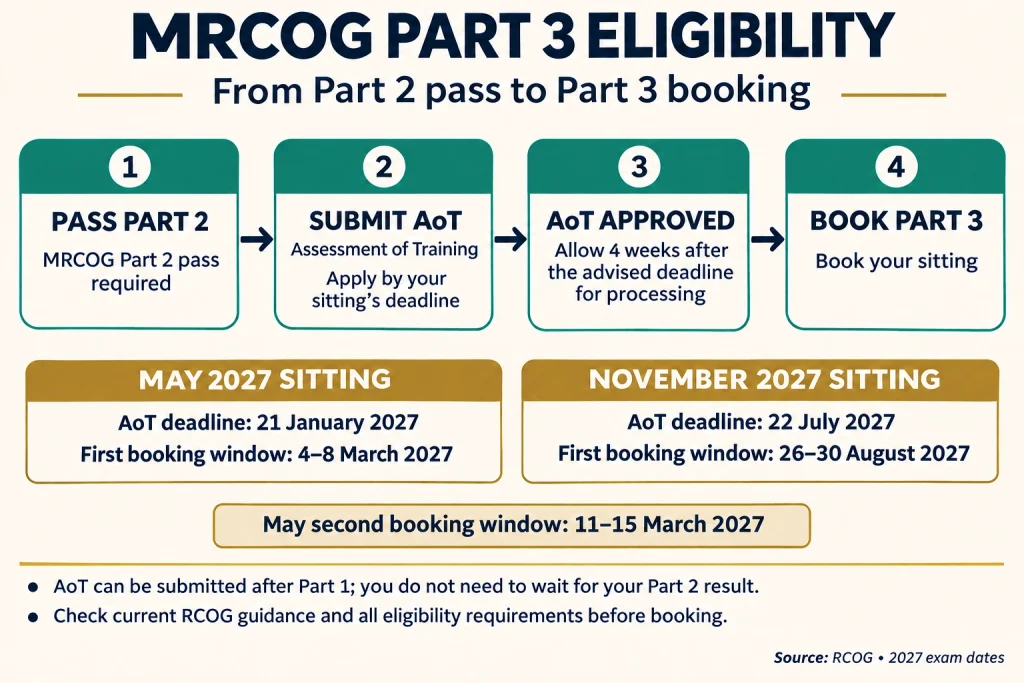
Each Part 3 sitting has its own AoT deadline, and the RCOG asks you to allow 4 weeks after the advised deadline for processing. In practice, that makes the AoT deadline the real start line for MRCOG Part 3 eligibility, not the booking window.
| Sitting | AoT deadline | Address and email update deadline | First booking window | Exam |
|---|---|---|---|---|
| May 2027 | Thu 21 Jan 2027 | Mon 25 Jan 2027 | Thu 4 to Mon 8 Mar 2027 | 5, 6, 10 and 11 May 2027 |
| November 2027 | Thu 22 Jul 2027 | Mon 26 Jul 2027 | Thu 26 to Mon 30 Aug 2027 | 10, 11, 15 and 16 Nov 2027 |
The May 2027 sitting also has a second booking window, Thu 11 to Mon 15 Mar 2027. For fees and the latest windows, see our MRCOG Part 3 booking dates page, which we update every sitting.
Time limits and attempts
Two rules sit alongside MRCOG Part 3 eligibility and can quietly close the door if you ignore them. You must attempt Part 3 within 7 years (pro rata) of passing Part 2, and every candidate has 4 attempts.
| Rule | Detail |
|---|---|
| Time limit | Attempt Part 3 within 7 years (pro rata) of passing Part 2 |
| Attempts | 4 for everyone |
| After 4 unsuccessful attempts | Retake Part 2 |
| Non-attendance | Not counted as an attempt; the fee is generally forfeited |
Seven years sounds generous until a job move, a pregnancy or a visa process takes two of them. If you have passed Part 2 and are unsure whether you are still within the limit, check with the RCOG before you plan your preparation around a sitting.
Preparing your AoT documents
Good Assessment of Training applications are usually the boring, well-organised ones. Start collecting evidence while you are still in the posts, because chasing a hospital for a letter about a job you left four years ago is slow.
A sensible starting set, in general terms, is:
- Your registration details and the date of registration
- Appointment or experience letters for each O&G post, showing dates, grade and whether full or part time
- A simple timeline of every post since registration, with any gaps explained
- Supervisor contact details where the RCOG asks for them
Follow the RCOG’s own guidance on Assessment of Training evidence where it differs from ours, and keep scanned copies with clear file names. Make sure the name on every document matches your RCOG account, and keep your address and email current before the update deadline, so nothing goes astray.
What to do once you are eligible
Once your MRCOG Part 3 eligibility is confirmed, the work shifts to the exam itself. The circuit has 14 tasks of 12 minutes, and our guide to the MRCOG Part 3 exam format explains the task types, domains and examiners.
From there, build a timed practice plan. Our step-by-step Part 3 preparation strategy gives a 12-week timetable that starts from your AoT approval and finishes on exam day.
Frequently asked questions
What are the MRCOG Part 3 eligibility requirements?
You need a Part 2 pass and an approved Assessment of Training. Both must be in place before you can apply.
When can I apply for AoT?
You can apply any time after passing Part 1. Applying early means your Assessment of Training is not the bottleneck once you pass Part 2.
How long does AoT approval take?
The RCOG asks you to allow 4 weeks after its advised deadline for processing. For the May 2027 sitting, the AoT deadline is Thursday 21 January 2027.
Which AoT route do doctors outside the UK use?
Route A is for UK trainees at ST3 or above, so most doctors training elsewhere use Route B. That needs 4 years full-time equivalent in O&G posts after registration, 2 of them within the last 4 years.
Is there a time limit after passing Part 2?
Yes. To keep your MRCOG Part 3 eligibility, you must attempt Part 3 within 7 years (pro rata) of passing Part 2, and you have 4 attempts in total.
Does missing the exam count as an attempt?
No. Non-attendance is not counted as an attempt, but the fee is generally forfeited.
Talk to our MRCOG team if you are unsure where you stand, or see how the MRCOG Part 3 course fits around your AoT and booking dates.
Related guides: MRCOG Part 3 preparation · MRCOG Part 3 exam format · MRCOG Part 3 booking dates · MRCOG Part 3 mock exams · MRCOG Part 3 results
Sources: RCOG: Part 3 how to apply · RCOG: Part 3 key dates and fees · RCOG: Part 3 FAQs