
A well-structured MRCOG Part 1 study plan rests on three essential habits: following the RCOG syllabus, practising Single Best Answer (SBA) questions every week, and completing full timed mock exams during the final six weeks.Many working doctors plan for about 16 weeks, and 12 can work if your science base is recent and your study time is protected.
This guide covers the exam format, how to use the syllabus, two week-by-week plans, SBA technique, studying around clinical work, common mistakes and a final-month checklist.
Table of Contents
What MRCOG Part 1 preparation has to cover
An effective MRCOG Part 1 study plan should help candidates build strong core knowledge while developing the stamina required to complete two examination papers in one day. Part 1 is a computer-based exam taken at Pearson VUE centres, and the RCOG does not publish a fixed pass mark.
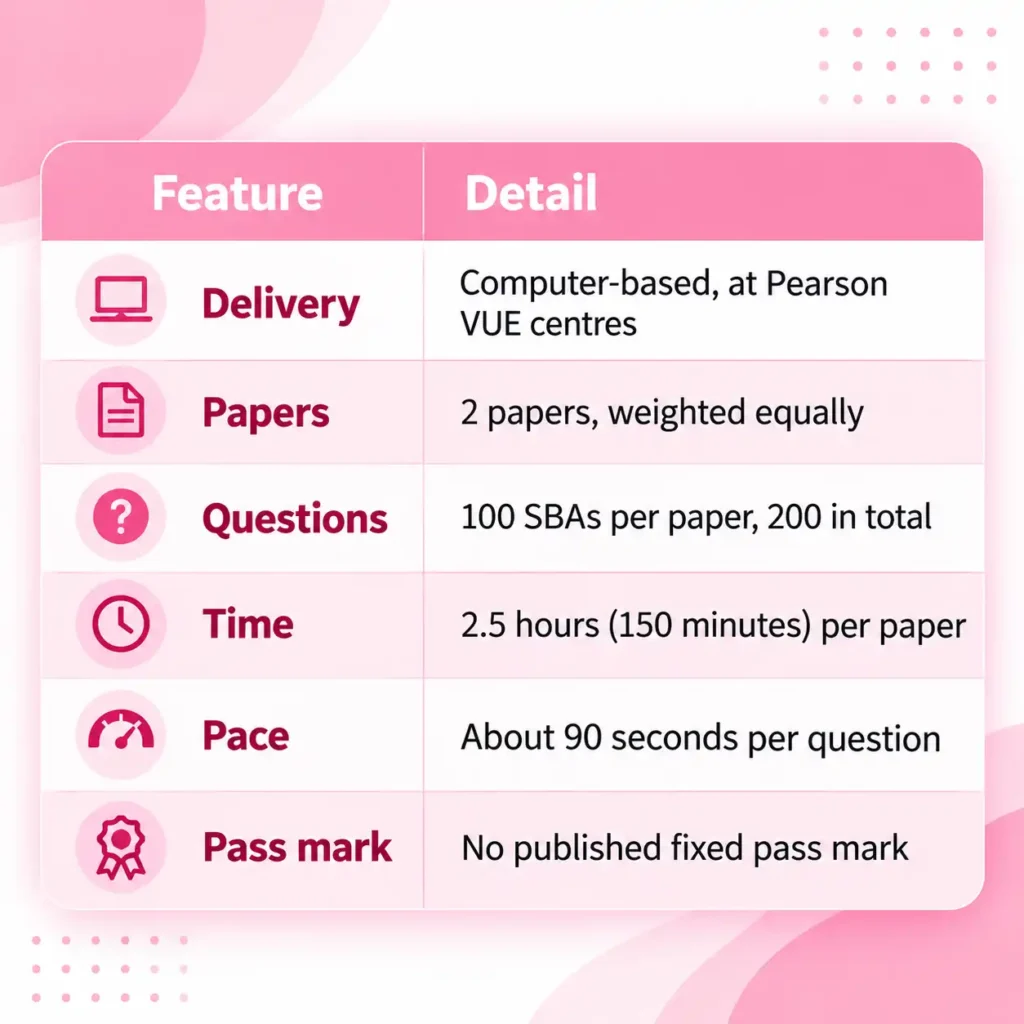
Ninety seconds a question leaves little room to reason from first principles, so MRCOG Part 1 preparation has to make the commonest facts automatic. Five hours of testing is also tiring, which is why full-length practice papers belong in every plan. For how Part 1 fits with Parts 2 and 3, see our guide to what MRCOG is, and check the RCOG Part 1 exam format page for the official detail.
Start your MRCOG Part 1 preparation with the syllabus
The RCOG Part 1 syllabus is your checklist of what to know. It is not a guide to how many questions each topic gets, and any list quoting exact topic percentages is guesswork.
Use the RCOG syllabus to create a structured MRCOG Part 1 study plan and track your progress across every examination topic. Copy each knowledge requirement into a spreadsheet with columns for “read”, “SBAs done”, “accuracy” and “revised”, then rate every line red, amber or green after a baseline set of questions rather than from memory of medical school.
Plan your reading from the red lines first. Give weak areas more time, but touch every line at least once, because a gap anywhere can cost marks. The plans below split the syllabus into three reading blocks; group the modules in whatever way suits your strengths.
A 16-week MRCOG Part 1 preparation plan
This 16-week MRCOG Part 1 study plan is suitable for doctors working full-time clinical schedules who can dedicate approximately 12 to 15 hours per week to exam preparation. The question volumes are suggestions, so adjust them to your rota, and keep an error log (topic, why you got it wrong, the fact you were missing) from week 1.
| Weeks | Focus | Output by end of block |
| 1 and 2 | Read the syllabus, build your tracker, do an untimed baseline of about 100 mixed SBAs, fix weekly study slots | Rated tracker and a timetable |
| 3 to 6 | Reading block 1: your weakest third of the syllabus. About 150 to 200 topic-matched SBAs a week | Short notes, error log started |
| 7 to 10 | Reading block 2: the next third. About 200 SBAs a week, including one mixed set of 50 | Notes for blocks 1 and 2, updated weak list |
| 11 and 12 | Reading block 3: the remaining modules. First full timed mock (2 × 100 SBAs, 150 minutes each, same day) | Mock 1 broken down by topic |
| 13 and 14 | Mixed timed sets of 50 at 90 seconds per question; second full mock at the end of week 14 | Top 10 weak topics |
| 15 | Targeted revision of the top 10; rapid review of all notes; optional third mock | Error log reviewed twice |
| 16 | Light revision, high-yield facts and exam-day logistics | Final-week checklist done |
In any MRCOG Part 1 preparation plan, the order matters more than the exact numbers. Starting with your weakest areas means they get revisited three or four times before the exam, instead of being crammed in the final fortnight.
A 12-week plan when time is shorter
A 12-week MRCOG Part 1 study plan requires focused reading, consistent SBA practice and at least two full-length mock examinations to cover the syllabus effectively within a shorter timeframe.Choose it if you have sat Part 1 before, studied the sciences recently, or can protect around 18 to 20 hours a week.
| Weeks | Focus |
| 1 | Tracker, baseline of about 100 mixed SBAs, fixed timetable |
| 2 to 4 | Reading block 1, about 200 to 250 SBAs a week |
| 5 to 7 | Reading block 2, about 250 SBAs a week including a mixed set of 50 |
| 8 | Reading block 3 and your first full timed mock |
| 9 and 10 | Daily mixed timed sets; second full mock at the end of week 10 |
| 11 | Targeted revision and error log review |
| 12 | Light revision and logistics |
Count back from your sitting when you set a start date for your MRCOG Part 1 preparation. Booking for January 2027 runs from Tuesday 27 October to Tuesday 15 December 2026 for candidates who submitted an Expression of Interest (EOI) by the 2 October deadline.
| Sitting | Eligibility deadline | EOI deadline | Booking window | Exam | Results |
| January 2027 | Check RCOG | Fri 2 Oct 2026 | 27 Oct to 15 Dec 2026 | Tue 19 Jan 2027 | Wed 17 Feb 2027 |
| July 2027 | Tue 16 Mar 2027 | Tue 30 Mar 2027 | 20 Apr to 15 Jun 2027 | Tue 13 Jul 2027 | Wed 11 Aug 2027 |
If this is your first attempt, start the paperwork alongside your MRCOG Part 1 preparation. First-time candidates submit an eligibility application with proof of their primary medical degree, certified by someone such as a notary public or lawyer (never a relative or yourself), and then an EOI for every sitting. Our MRCOG Part 1 and Part 2 booking dates guide is updated each sitting.
SBA technique for MRCOG Part 1 preparation
Developing strong SBA techniques is an essential part of your MRCOG Part 1 study plan. Start by reading the question lead-in and predicting the answer before reviewing the available options.Several options are often partly true, so your job is to find the single best one.
Read the last line before the stem, so you know whether you are being asked for a mechanism, a value, a structure or a test. Then cover the options, form your answer and look for it; this stops a plausible distractor from leading you. Strike out options that are wrong or that answer a different question.
If you cannot decide within about 90 seconds, pick your best option, flag it and come back at the end. When you review practice sets during your MRCOG Part 1 preparation, treat a lucky guess like a wrong answer and add both to your error log. Learn why each distractor is wrong, because concepts are tested from different angles and memorised answers rarely transfer. Our guide on revising SBAs for MRCOG Part 1 goes deeper.
Resources and studying around clinical work
A practical MRCOG Part 1 study plan should include three essential resources: the official RCOG syllabus, a core basic sciences textbook for Obstetrics and Gynaecology, and a reliable SBA question bank.Collecting more resources than you can complete is one of the quietest ways to lose a sitting.
Doctors managing busy clinical rotas can follow an effective MRCOG Part 1 study plan by scheduling shorter daily study sessions instead of relying only on lengthy weekend revision. Map your rota four weeks ahead and book study like clinics, for example 60 to 90 minutes on most weekdays and a longer block on one day off. After night shifts, switch to recorded lectures and question sets and keep heavy reading for rested days.
A small weekly study group helps too, especially for topics you find dry. Our guide on balancing MRCOG Part 1 preparation with clinical duties has sample timetables for different rotas.
Common mistakes and a final-month checklist
During the final four weeks of your MRCOG Part 1 study plan, avoid introducing new study resources and focus on revising key concepts, reviewing your error log and completing timed mock examinations. Sit your final full timed mock no later than 10 days before the exam, review your error log twice and re-test your 10 weakest topics. Make a one-page sheet of formulae, normal values and statistics definitions.
Check your Pearson VUE confirmation email for the centre address, start time and ID requirements, and practise at the same time of day with a break between papers. Protect your sleep in the final week, and keep the last day light.
Frequently asked questions
How many months does MRCOG Part 1 preparation take?
Many working doctors follow a 16-week MRCOG Part 1 study plan, which provides approximately four months to cover the syllabus, practise SBAs and complete mock examinations. With a recent science base and protected time, 12 weeks can be enough, but start earlier rather than studying longer hours if you have heavy on-call duties.
How many SBAs should I practise for Part 1?
There is no official number. Our plans suggest 150 to 250 SBAs a week, roughly 2,000 to 3,000 questions in total plus at least two full mocks, and careful review matters more than raw volume.
Does the RCOG publish topic weightage for Part 1?
No. Cover every area of the syllabus and use your own mock results to decide where your MRCOG Part 1 preparation needs extra time.
Can I manage MRCOG Part 1 preparation while working full time?
Yes, many candidates do. Short daily slots planned around your rota, lighter tasks after nights and weekly timed sets make it manageable.
How long is a Part 1 pass valid for?
You must attempt Part 2 within 10 years of passing Part 1 (7 years pro rata on the UK Specialist Register route). Check the RCOG Part 1 FAQs for the current rules.
Is there a limit on Part 1 attempts?
A maximum of 6 attempts applies only to candidates on the UK Specialist Register route. For everyone else there is no limit, though each attempt costs time and fees, so it pays to make your MRCOG Part 1 preparation count first time.
Want structured MRCOG Part 1 preparation with mentors and timed mocks? Talk to our MRCOG team or see our MRCOG Part 1 course, which follows the RCOG syllabus with SBA practice and full mocks. When you pass, our MRCOG Part 2 preparation strategy picks up where this guide ends.
Related guides: What is MRCOG · MRCOG Part 1 and Part 2 results · Why candidates fail MRCOG Part 1 · Balancing Part 1 with clinical duties · Final weeks before the exam
Sources: RCOG Part 1 exam format · RCOG Part 1 syllabus · RCOG Part 1 key dates and fees · RCOG Part 1 FAQs