
The MRCOG full form is Member of the Royal College of Obstetricians and Gynaecologists, the membership awarded by the RCOG in the UK to doctors who pass all three parts of its specialty exam. Those five letters after a name tell you the doctor has cleared a demanding, three-stage assessment in obstetrics and gynaecology. If you want the whole picture of the exam, its eligibility and its value, start with our main guide on what is MRCOG.
This guide covers what each letter stands for, what membership does and does not mean, the three exam parts at a glance, and how related terms such as RCOG, DRCOG and FRCOG fit together.
Table of Contents
What each letter of MRCOG stands for
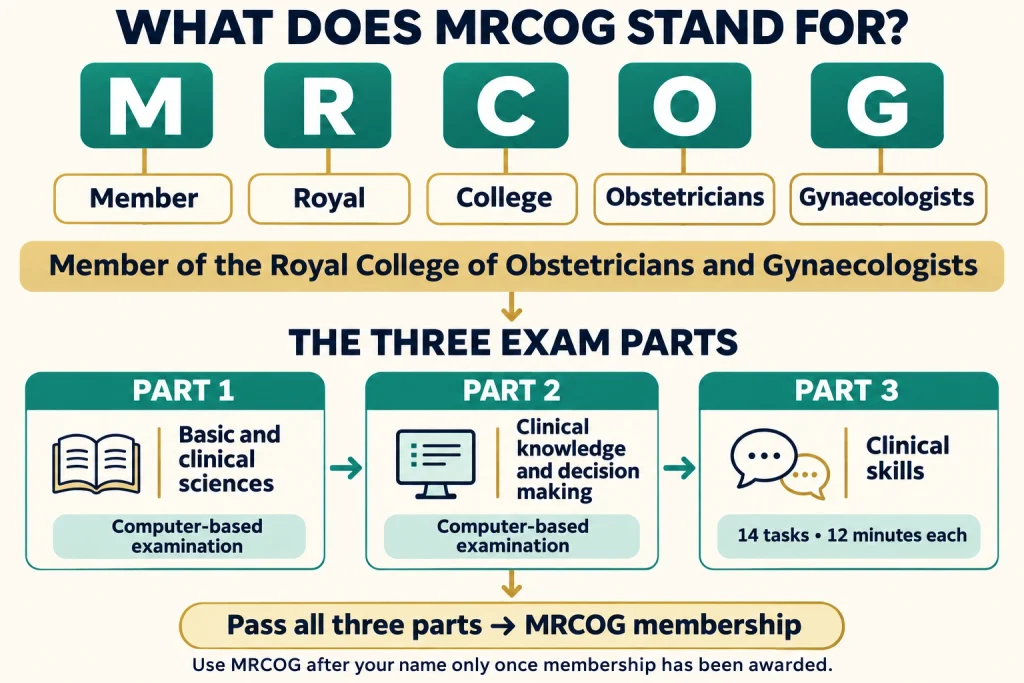
The MRCOG full form breaks down neatly, because each letter is the first letter of one word in the College’s name. Read in order, they spell out who awards the membership and which specialty it covers.
| Letter | Stands for | What it tells you |
|---|---|---|
| M | Member | The holder is a member of the College, not a fellow or diplomate |
| R | Royal | Part of the College’s official name |
| C | College | A professional college, not a university degree |
| O | Obstetricians | Pregnancy, labour and the postnatal period |
| G | Gynaecologists | Health of the female reproductive system |
Notice the British spelling in the MRCOG full form: gynaecologists, with “ae”. You will see “gynecologists” in some American sources, but the official name of the College uses the British form, so that is the one to use on a CV, an application or a letter.
What membership of the RCOG means
Membership, the M in the MRCOG full form, means you have passed Part 1, Part 2 and Part 3 of the MRCOG exam, and completing all three leads to the award of MRCOG. There are no exemptions, so every candidate sits every part, whatever other qualifications they already hold.
It is worth being clear about what the letters do not mean. MRCOG is a postgraduate qualification from a professional college, not a licence to practise. On its own it does not make you a specialist or a consultant anywhere; that depends on the medical regulator in the country where you work and on your experience. For a fuller discussion of how it can help your career, see our guide to the benefits of MRCOG.
The three parts behind the letters
Behind the MRCOG full form sit three separate exams, taken in order. Each one tests something different, from basic science through clinical knowledge to how you perform with patients and colleagues.
| Part | Format | Focus |
|---|---|---|
| Part 1 | Computer based; 2 papers of 100 single best answer questions (SBAs), 2.5 hours each | Basic and clinical sciences behind O&G |
| Part 2 | Computer based; 2 papers, each 50 SBAs and 50 EMQs, 3 hours each | Clinical knowledge and decision making |
| Part 3 | 14 tasks of 12 minutes each, including 2 minutes’ reading | Clinical skills across five domains, held in May and November |
Parts 1 and 2 are taken at Pearson VUE centres, while Part 3 is a clinical assessment held at RCOG exam centres. If you are getting ready for a particular stage, our MRCOG Part 1 course, MRCOG Part 2 course and MRCOG Part 3 course each map to one exam.
Related terms: RCOG, DRCOG and FRCOG
Several abbreviations look like the MRCOG full form but mean something quite different. Mixing them up is common, especially in early job applications, so here is how they compare.
| Term | Full form | What it is |
|---|---|---|
| RCOG | Royal College of Obstetricians and Gynaecologists | The College itself, which sets and runs the exams |
| MRCOG | Member of the RCOG | Awarded after passing all three parts of the exam |
| DRCOG | Diploma of the RCOG | A diploma for non O&G specialists, such as GPs and junior doctors |
| FRCOG | Fellow of the RCOG | Fellowship, elected after normally 10 or more years as a member |
DRCOG suits doctors who want sound O&G knowledge for general practice, while MRCOG is for those building a career in the specialty. FRCOG is not an exam at all; it is an honour the College confers on established members. Our comparisons of MRCOG vs DRCOG and MRCOG vs FRCOG go into more detail.
Using the MRCOG full form correctly
Write “MRCOG” after your name only once all three parts are passed and the College has awarded membership. Before that, list each part you have passed as an exam result with the year, rather than as post-nominal letters.
When you spell out the MRCOG full form on a CV or in a cover letter, use the College’s exact wording and British spelling. Recruiters and regulators read many applications, and getting a basic title right shows care. It also helps to say where you are on the path, for instance “Part 2 passed, preparing for Part 3”, so a reader knows exactly what you hold.
Where to go after learning the MRCOG full form
Knowing what the letters mean is a starting point, not the whole story. The next question most doctors ask is what the exam involves and whether it suits their plans.
Our guide on what is MRCOG explains eligibility, timelines and recognition in one place. If you prefer to learn by watching, our MRCOG video hub gathers short explainers on each part. For the official description, read the RCOG’s own MRCOG overview.
Frequently asked questions
What is the MRCOG full form?
It stands for Member of the Royal College of Obstetricians and Gynaecologists. The membership is awarded by the RCOG to doctors who pass all three parts of its exam.
Is MRCOG a degree?
No. The MRCOG full form describes a postgraduate membership from a professional college, not a university degree, and it is not a licence to practise on its own.
How many parts does the MRCOG exam have?
There are three parts. Part 1 and Part 2 are computer-based written exams, and Part 3 is a clinical assessment of 14 tasks.
What is the difference between MRCOG and FRCOG?
MRCOG is earned by passing the exam. FRCOG is a fellowship the College elects members to, normally after 10 or more years of membership.
Can I write MRCOG after my name once I pass Part 1?
No. You use the letters only after all three parts are passed and membership is awarded; until then, list the parts you have passed as exam results.
Why is it spelt “Gynaecologists” and not “Gynecologists”?
The RCOG is a UK college and uses British spelling, so the MRCOG full form is always written with “ae”.
Talk to our MRCOG team if you want help choosing where to start.
Related guides:
- What is MRCOG? Eligibility, parts and recognition
- Benefits of MRCOG for your career
- MRCOG vs FRCOG: key differences
- MRCOG vs DRCOG: which one suits you
Sources: